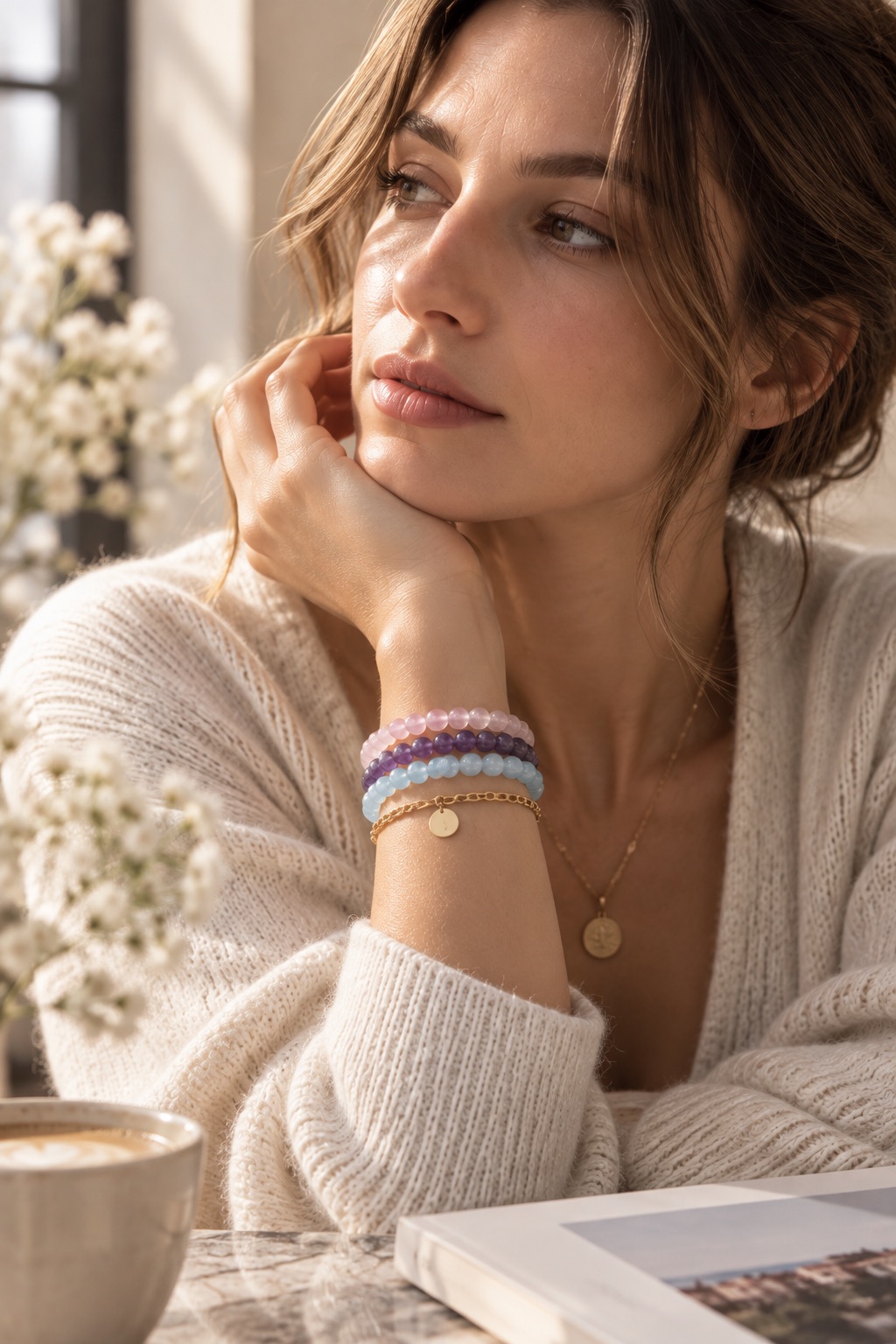
A bracelet can look delicate in a close-up and feel surprisingly bold once it’s on your wrist. Product photos help you choose a color, but they don’t always tell you how much space the beads will take up—or how the bracelet will sit beside a watch or under a shirt cuff.
Before choosing, separate two measurements: bead diameter and bracelet fit. A listing that says “6mm” describes the beads, not the wrist the bracelet will fit.
Here’s how to make sense of both, then choose a combination you’ll enjoy wearing.
Start with the look you want
Think about what you already wear.
If you usually choose a fine chain or a small pendant, a strand of smaller beads is a sensible place to start. If you want the bracelet to be the main detail in an otherwise simple outfit, consider larger beads or a stronger color.
Color changes the effect, too. Pale pink sits softly against a light sleeve, while purple creates a more distinct line around the wrist. A pale-blue strand can still stand out if the beads have a fuller silhouette.
Styling images can help you explore those combinations, but they don’t establish a bead’s material, exact diameter, or weight. Check those details in the description before buying.
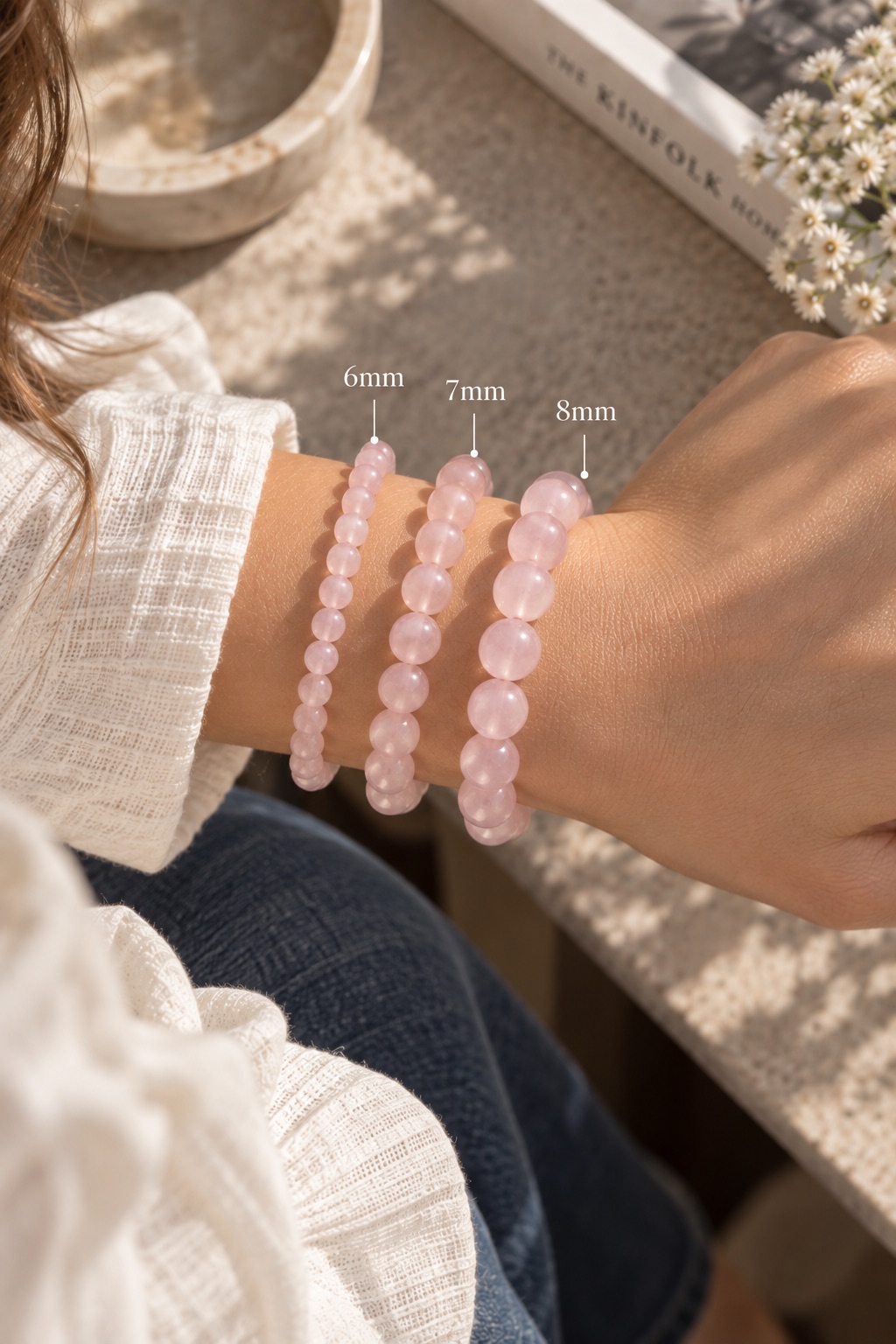
What changes between 6mm, 7mm, and 8mm beads?
For round beads, the millimeter measurement refers to the diameter of an individual bead. The difference between 6mm and 8mm is just 2mm across each bead, but that change repeats around the entire bracelet.
| Bead size | Visual effect | Consider it if… |
|---|---|---|
| 6mm | A finer line around the wrist | You prefer understated jewelry or want to layer several strands |
| 7mm | A middle step between fine and fuller beads | You want a little more presence without moving straight to 8mm |
| 8mm | A fuller, more noticeable strand | You want to wear one bracelet as the main wrist accessory |
These are starting points, not rules about which size belongs on which wrist. A smaller wrist can wear a bold bracelet; a larger wrist can wear a fine strand. Choose the proportion you like, then check the fit separately.
A dark strand can draw more attention than a pale strand of the same diameter. Compare similar colors when you’re trying to judge size alone.
Be careful with close-up photos
A bracelet that fills the screen may still have small beads. Camera distance, cropping, and wrist proportions all affect how large it appears.
For a more useful reference, measure a round bead on a bracelet you already own. A ruler can give you a rough comparison; calipers are better for checking small differences. Keep that measurement in mind when looking at another design.
Measure your wrist before choosing a bracelet size
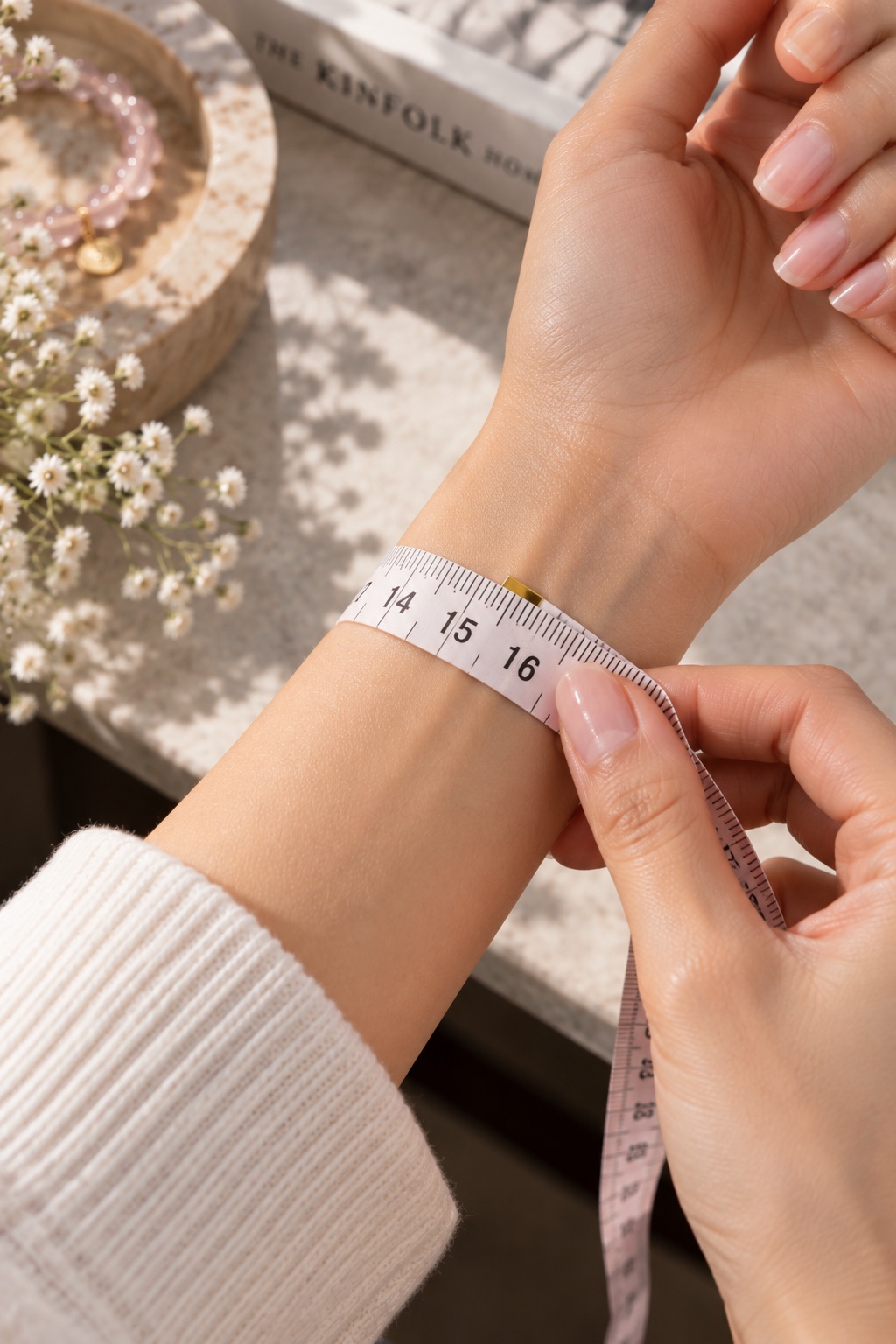
Use a flexible measuring tape around the place where you want the bracelet to sit. Keep it against your skin without pulling it tight, and read the measurement where the starting end meets the tape.
If you don’t have a measuring tape:
- Wrap a narrow strip of paper around your wrist.
- Mark where the end overlaps.
- Lay it flat and measure from the starting end to the mark.
Record the actual wrist measurement first. Add any allowance only after checking how the seller defines its sizes.
Check what the size on the listing means
“Bracelet size” can refer to a recommended wrist measurement, an inside circumference, or the length of the strand laid flat. Those measurements are not interchangeable.
For example, a bracelet recommended for a 6-inch wrist is not necessarily a bracelet measuring 6 inches from end to end. Beads take up space inside the loop, and larger beads can affect that space.
If the description is unclear, ask:
My wrist measures ___ inches/cm. Which size would you recommend for a fit with a little movement?
That gives the seller something more useful than “I have a small wrist.”
Decide how much movement you like
Some people want a bracelet to stay near the wrist bone. Others like it to slide slightly when they move. Consider when you’ll wear it: typing at a desk, wearing fitted sleeves, or stacking it beside other jewelry can make the same fit feel different.
Close fit: The bracelet stays mostly in place. It should not pinch or require the elastic to stay stretched while you wear it.
Some movement: The bracelet can shift slightly as you turn your wrist. This gives you room to move without letting the strand travel far down the hand.
Loose fit: The bracelet moves farther along the wrist and may sit lower toward the hand. Check that it won’t slip off during ordinary movement.
Don’t rely on stretch alone to solve a sizing mismatch. Elastic helps a bracelet pass over your hand; the finished bracelet still needs to fit your wrist.
Build a stack one strand at a time
Start with the bracelet you most want to wear, then add one supporting piece.
Try repeating pink across two strands, adding purple for contrast, and using clear-looking beads to provide a lighter band between colors. Repeated gold-tone details can connect the strands visually.
You can use that arrangement without matching every bracelet:
- Repeat one color across two strands.
- Add a contrasting color if you want more definition.
- Let one charm or larger bead be the focal point.
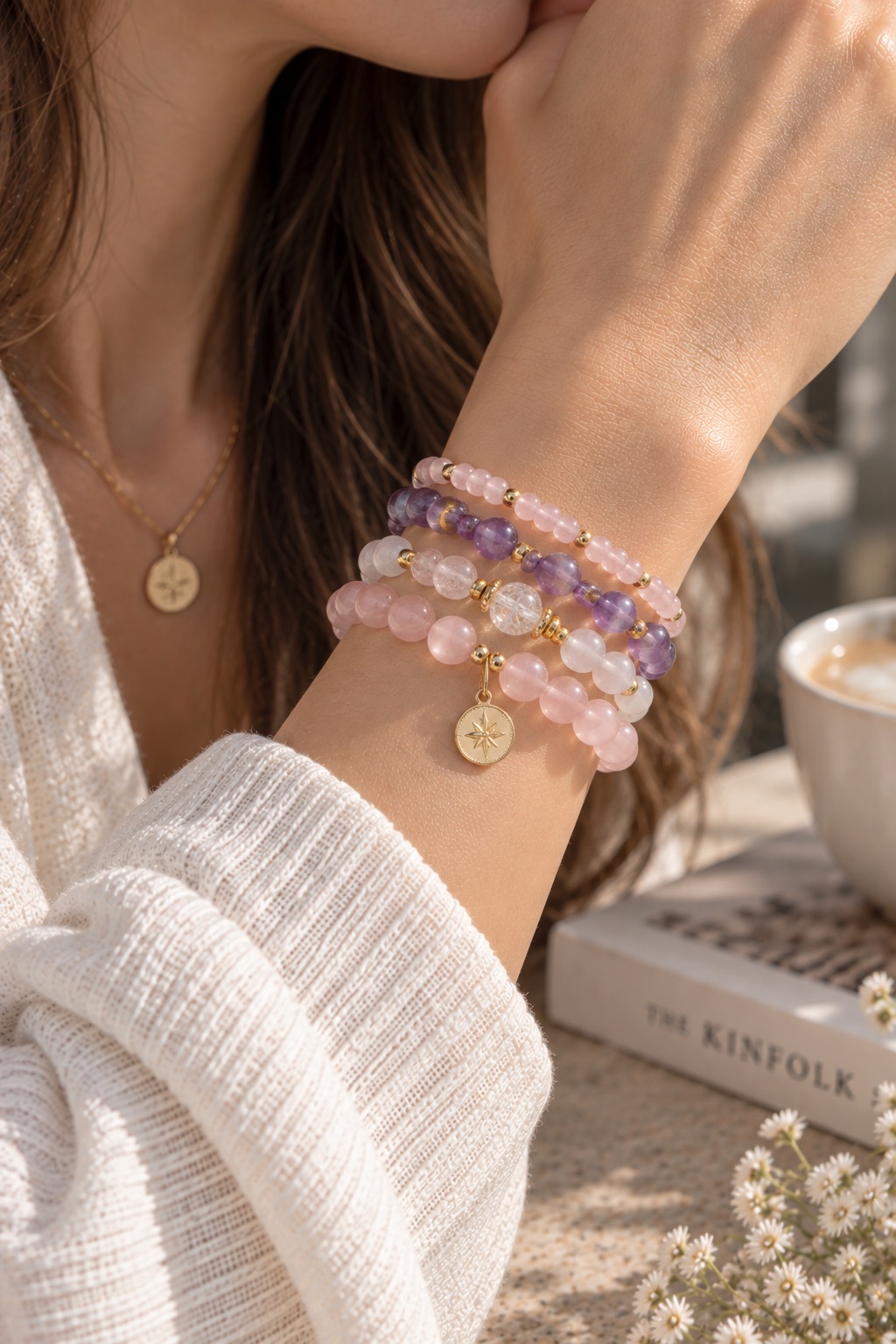
Try the stack with your actual sleeves and watch. Bend your wrist and rest your hand on a desk. If the bracelets crowd each other or make the cuff awkward, remove a strand and try again.
A single bracelet may work better for some days. There’s no required number of layers.
Before you place an order
Once you’ve chosen the look, check the details a photo can’t confirm:
- Material: Color alone doesn’t identify a gemstone or establish whether a bead is natural, manufactured, or treated.
- Fit: Look for the recommended wrist range and how the bracelet was measured.
- Construction: Check whether it uses elastic, a clasp, or an adjustable closure.
- Metal components: Confirm the material if you have known sensitivities.
- Returns: Read the sizing and return terms, especially when buying a gift.
If you’re choosing between two bead sizes, use the jewelry you already reach for as your reference. A finer strand makes sense if you like subtle accessories. A fuller strand is worth considering if you want one piece to carry the look.
For more beaded jewelry inspiration, visit Evara Vale.
Ready to choose? Browse our crystal bracelets, or go straight to a series if you already know what you want: the Luminelle series is the delicate end of the range, while Aqualume runs from 4 mm up to 8 mm so you can compare sizes side by side. If you’d rather not think about sizing at all, a double-wrap style covers more of the wrist with the same beads.
Sizing comes down to how much of the wrist you want the bracelet to cover — a 6 mm strand sits close and light, while an 8 mm or larger bead fills more of the wrist on its own.