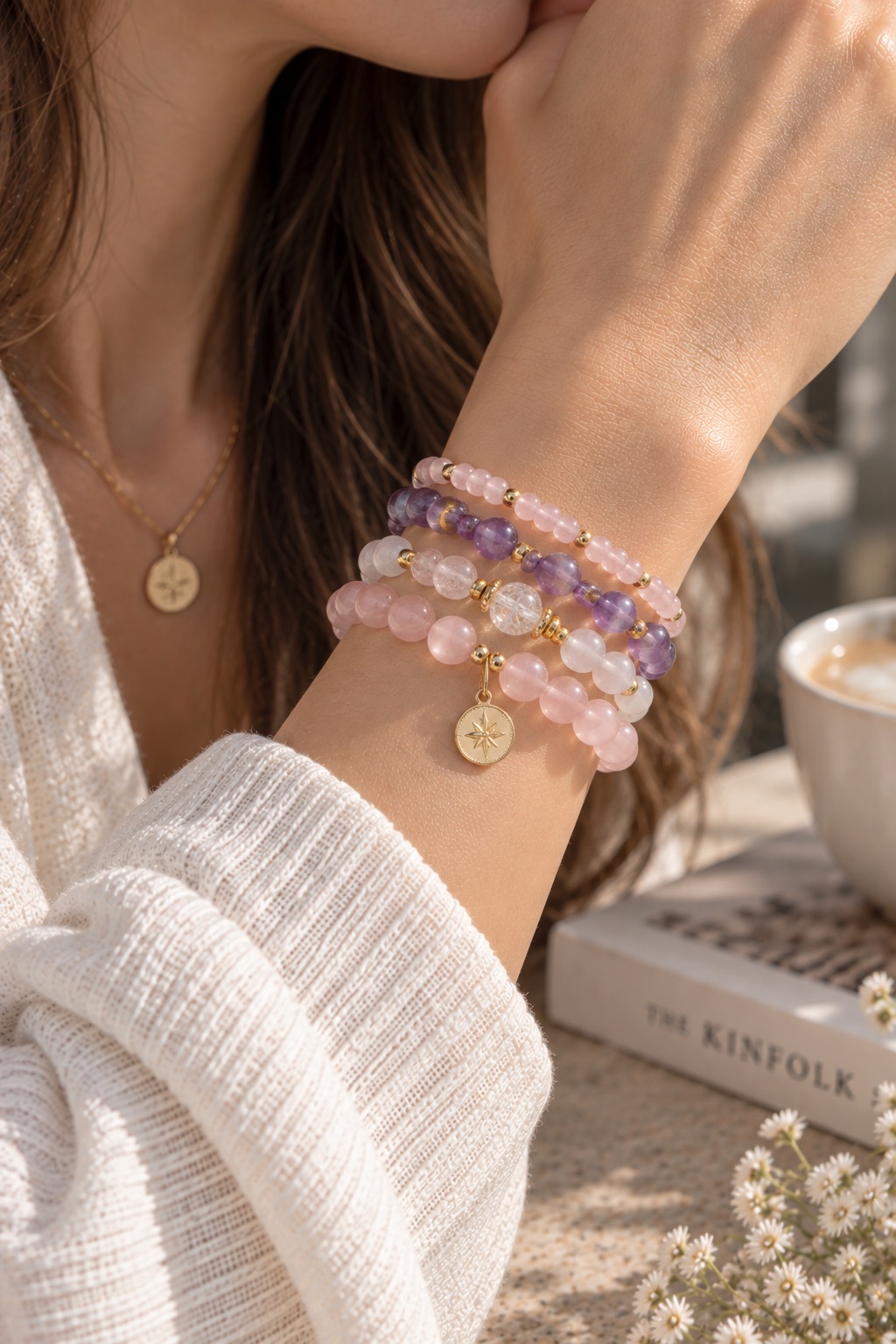
Can a crystal bracelet scratch your watch or phone? It depends on the materials and surfaces that meet, how often they rub or strike, and whether grit or coatings are involved. Contact alone does not prove damage.
It also helps to separate the parts you are concerned about. A watch face, case, and band are different surfaces; so are a phone screen, back, and protective case. There is no reliable one-word answer for every bracelet and every device. If you want to be cautious, avoid repeated contact and follow the care instructions for your particular device.
What does “crystal bracelet” mean?
“Crystal bracelet” is a broad product description, not the name of one specific material. Beads can be made from different minerals, glass, or other materials, and a bracelet may also include metal details or a charm. Color and appearance alone do not establish the material.
A bead, fitting, or charm may meet a device in a different way as you move. Without verified information about both pieces, it is not possible to promise that a pairing is scratch-proof or that damage is certain.
Watch face and watch case are different
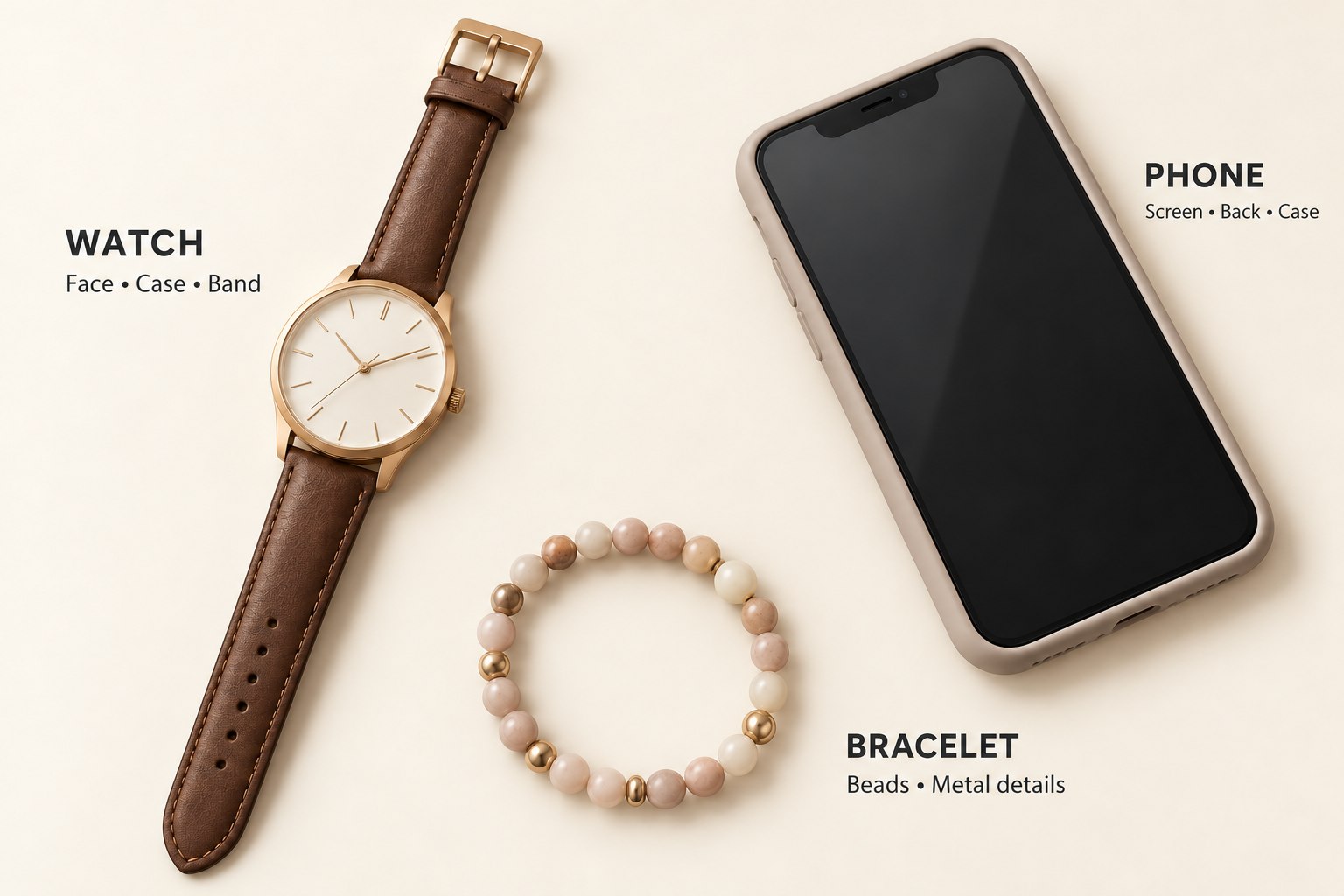
Editorial illustration: consider the watch, phone, and bracelet as separate surfaces and components.
When a bracelet sits next to a watch, it may touch the face, case, crown, clasp, or band. Those parts can have different materials and finishes. Check the watch maker’s product information and care guidance for the surfaces of your specific model.
Even if the bracelet never touches the watch face, it may repeatedly brush against the side or clasp. If the watch is valuable, vintage, plated, or especially important to keep in its present condition, wearing the bracelet on the other wrist is a simple way to avoid contact between them.
A phone screen is not the only surface to consider
A phone may have glass on the front or back, a coating on some surfaces, and a separate protective case. The case itself may also show wear. If your bracelet moves across the phone while you hold it, pay attention to repeated rubbing rather than judging the screen alone.
Apple advises that abrasive materials can diminish the iPhone’s fingerprint-resistant coating and may scratch the device. It also recommends removing dirt or sand and cleaning with a soft, lint-free cloth. That guidance supports keeping surfaces clean and following the instructions for your own model; it does not establish what any particular bracelet will do. Read Apple’s iPhone cleaning guidance.
A protective case can reduce direct contact with the phone, but the case may still acquire marks. Its material and condition matter too.
What Mohs hardness can—and cannot—tell you
Online advice sometimes compares a gemstone’s Mohs hardness with a watch crystal or phone screen and then declares the result certain. The Mohs scale is a relative scratch-hardness scale. It does not tell you how quickly everyday contact will cause wear or whether a coating will be affected.
The Gemological Institute of America explains that the scale ranks relative scratch hardness and that hardness is only one part of gemstone durability. A hardness number alone cannot predict the outcome for a particular bracelet and device. Read GIA’s explanation of gemstone durability.
How to reduce repeated contact
Wear the bracelet on the opposite wrist if you want to keep it away from a watch.
Lower and turn your wrist as you normally would. Notice whether beads or fittings keep striking or rubbing the watch.
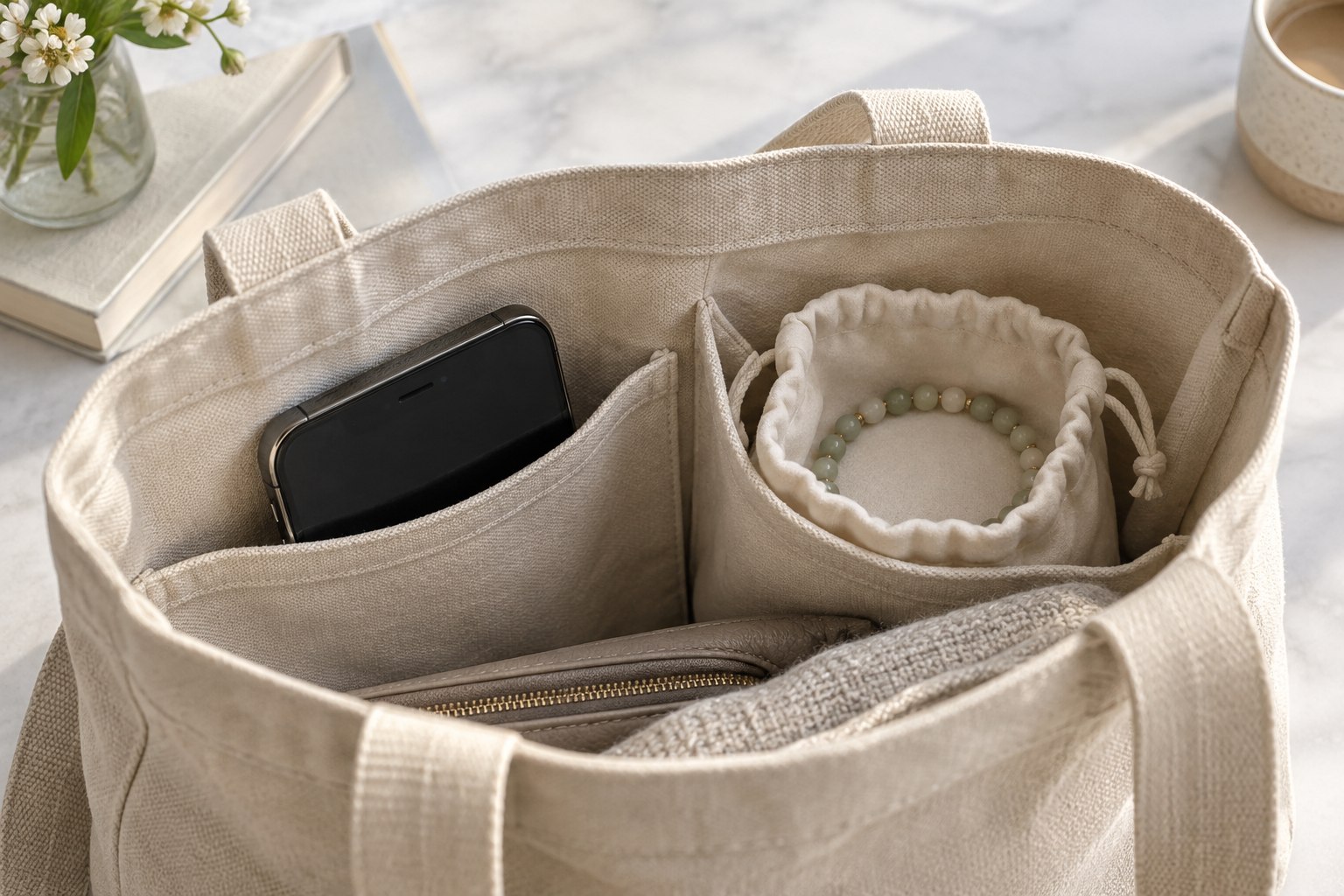
Keep a loose bracelet separate from your phone when you put them in a bag or pocket.
Remove visible grit and clean your device according to its maker’s instructions.
Take the bracelet off, or change wrists, if it repeatedly knocks against a desk or another hard surface.
Avoid scratch-testing a finished bracelet or device. The test itself can cause damage, and its result may not reflect ordinary wear.
Styling illustration: a soft pouch keeps a loose bracelet apart from a phone inside a bag.
Can you still wear a bracelet with a watch?
Yes, if the combination is comfortable and the pieces are not repeatedly rubbing or striking each other. Start with one bracelet and see where it naturally sits as you move. If it crowds the watch or the contact concerns you, move it to the other wrist.
It depends on the bracelet materials, the watch’s surfaces, and how the pieces contact each other. Check the watch maker’s materials and care instructions, and avoid repeated rubbing if you want to be cautious.
Can a crystal bracelet scratch a phone screen?
There is no reliable answer for every bracelet and phone. Keep surfaces clean, avoid repeated contact, and follow your phone maker’s care guidance.
Will a phone case prevent scratches?
A case can keep a bracelet from touching the phone itself, but the case may still show wear or marks. Protection depends on its design and material.
Does Mohs hardness prove that a bracelet will scratch a device?
No. Mohs hardness is a relative, qualitative scale. It does not, by itself, predict what repeated everyday contact will do to a particular device.
Explore bracelet designs
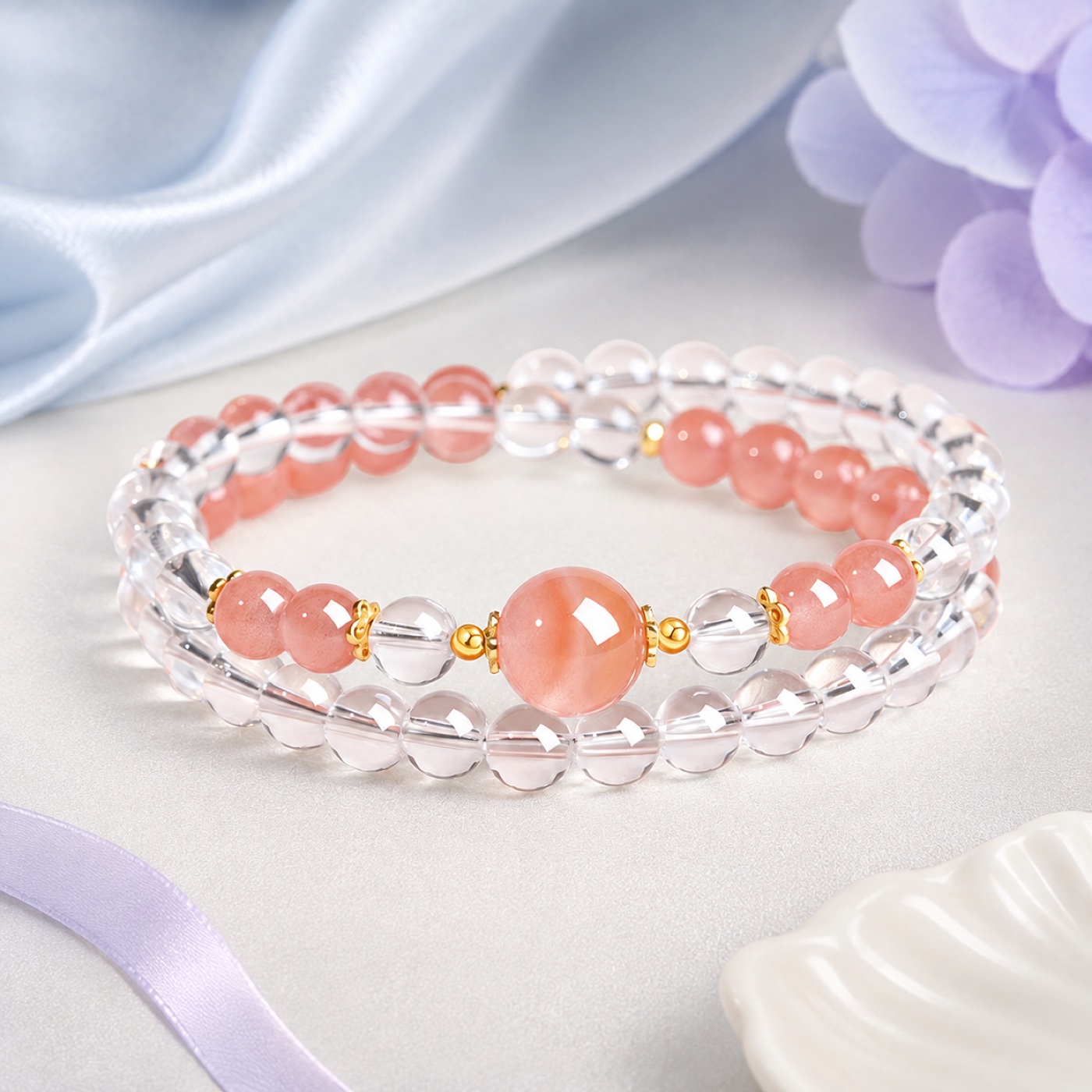
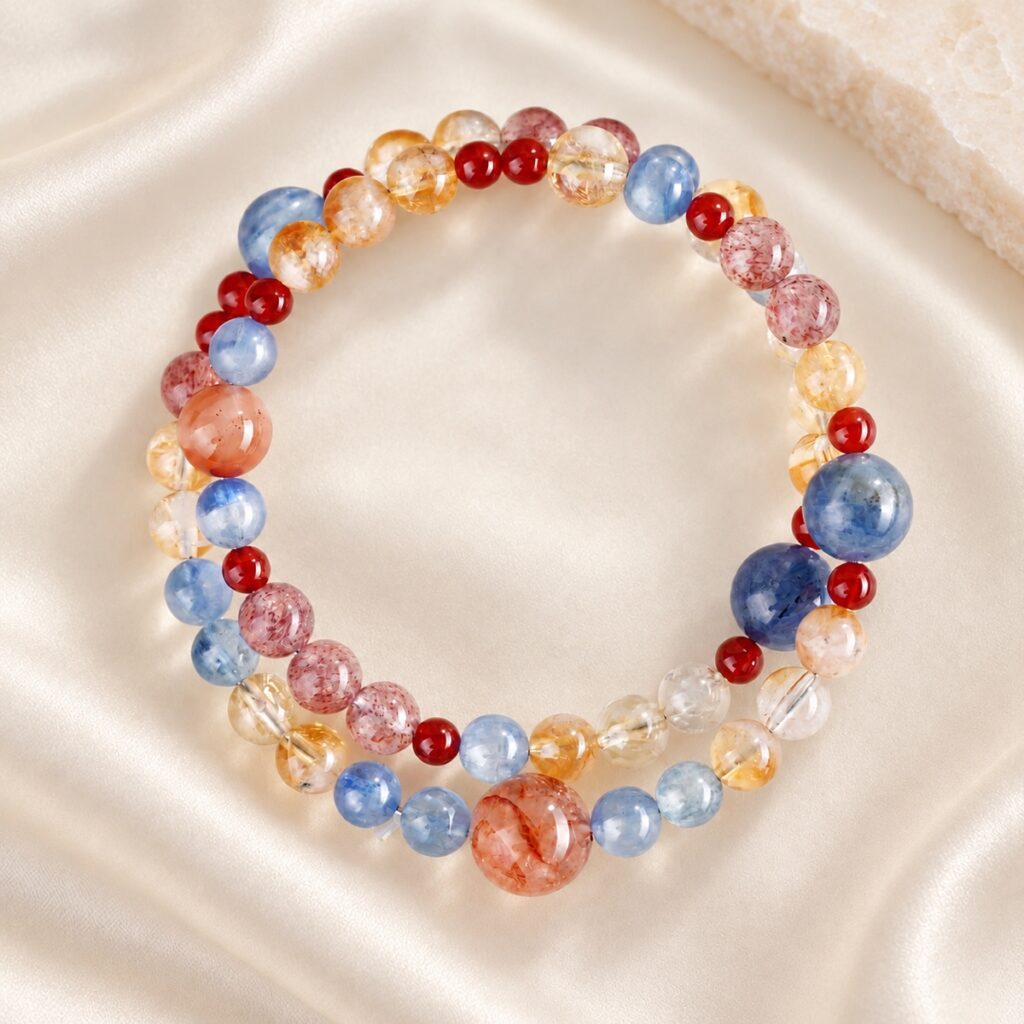
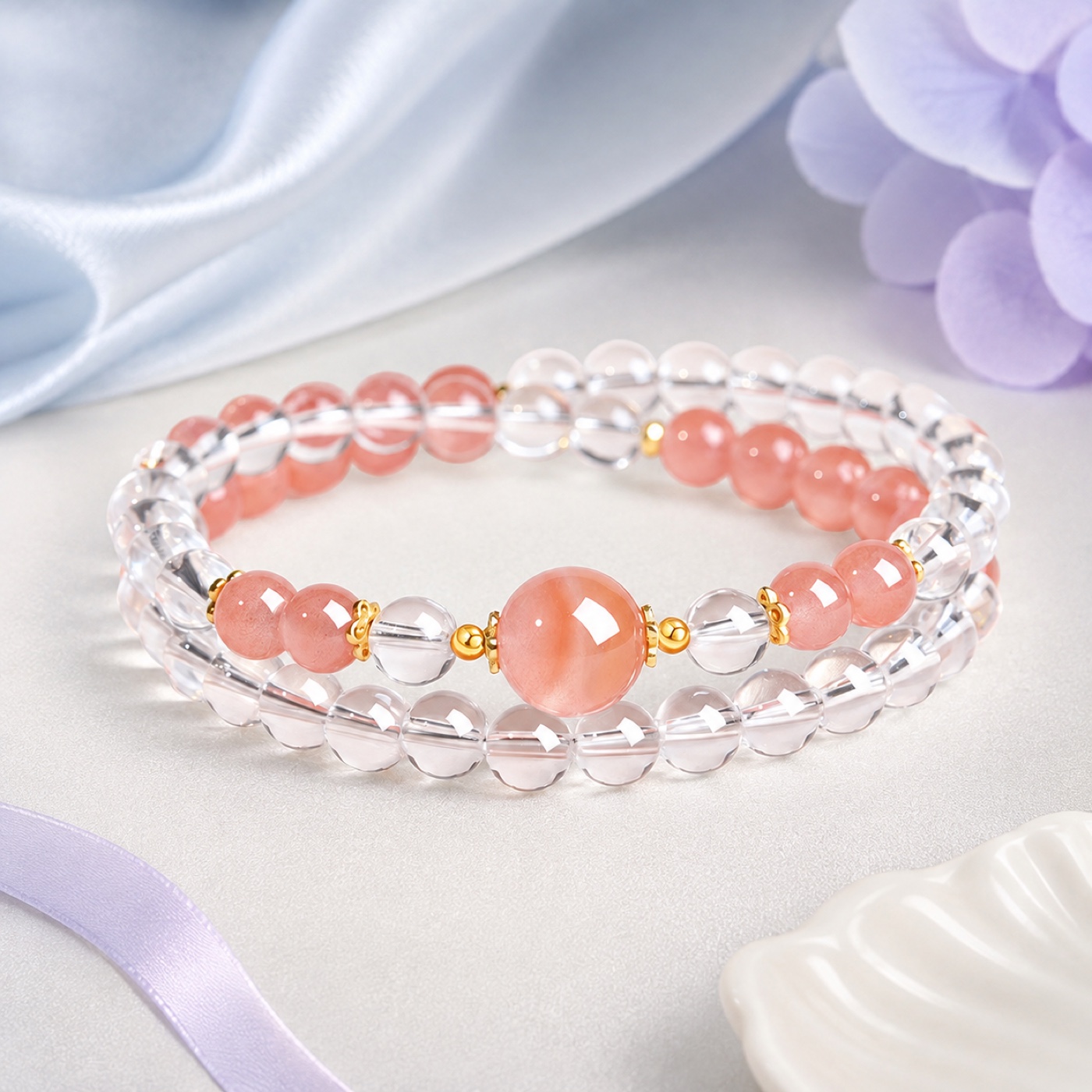
Clarity Arc Coral Focal Double-Wrap Bead Bracelet. Select the image to view product details.
Two beads in the same crystal bracelet can look surprisingly different. One may be clearer, darker, cloudier, or more strongly patterned than the bead beside it. That difference is not automatically a flaw—and it is not automatic proof that the material is natural, either.
The useful question is more specific: are you seeing normal variation inside the material, a change caused by lighting and photography, or physical damage that could affect wear? This guide gives you a practical way to inspect a bracelet without making claims that photos and home checks cannot support.
Start with a three-part check
Change the light. Look at the bracelet in indirect daylight, warm indoor light, and cool indoor light.
Rotate each bead. An internal feature often changes position or visibility as the bead turns; surface damage stays tied to one spot on the exterior.
Inspect the surface and drill holes. Chips, rough edges, and fractures that reach the surface deserve more attention than a cloud or line enclosed inside a polished bead.
Use a clean cloth first so fingerprints, lotion, and dust do not become part of the diagnosis. A phone flashlight can help, but avoid judging color from a single bright beam.
Why beads from one bracelet can vary
Materials used for beads do not all have a uniform appearance. Color and clarity can vary within one source material and between different pieces. When beads are cut and polished, those differences may appear side by side in a finished strand.
Color zoning and uneven saturation
A bead may be pale on one side and more saturated on the other. Another may show a band, patch, or gradual transition. Cutting orientation matters too: similar material can face the light differently after shaping.
Clouds, needles, crystals, and veils
Gemologists use the broad term inclusion for material or features enclosed within a gemstone. Depending on the material, inclusions may look like tiny crystals, fine needles, soft clouds, wispy veils, or internal fingerprints. The Gemological Institute of America explains that inclusions can provide useful identification clues, but interpreting them correctly requires training and magnification.
An inclusion can be stable and visually interesting, but its presence alone does not prove that a bead is natural, untreated, or correctly labeled. Synthetic and treated materials can also show internal features.
Transparency differences
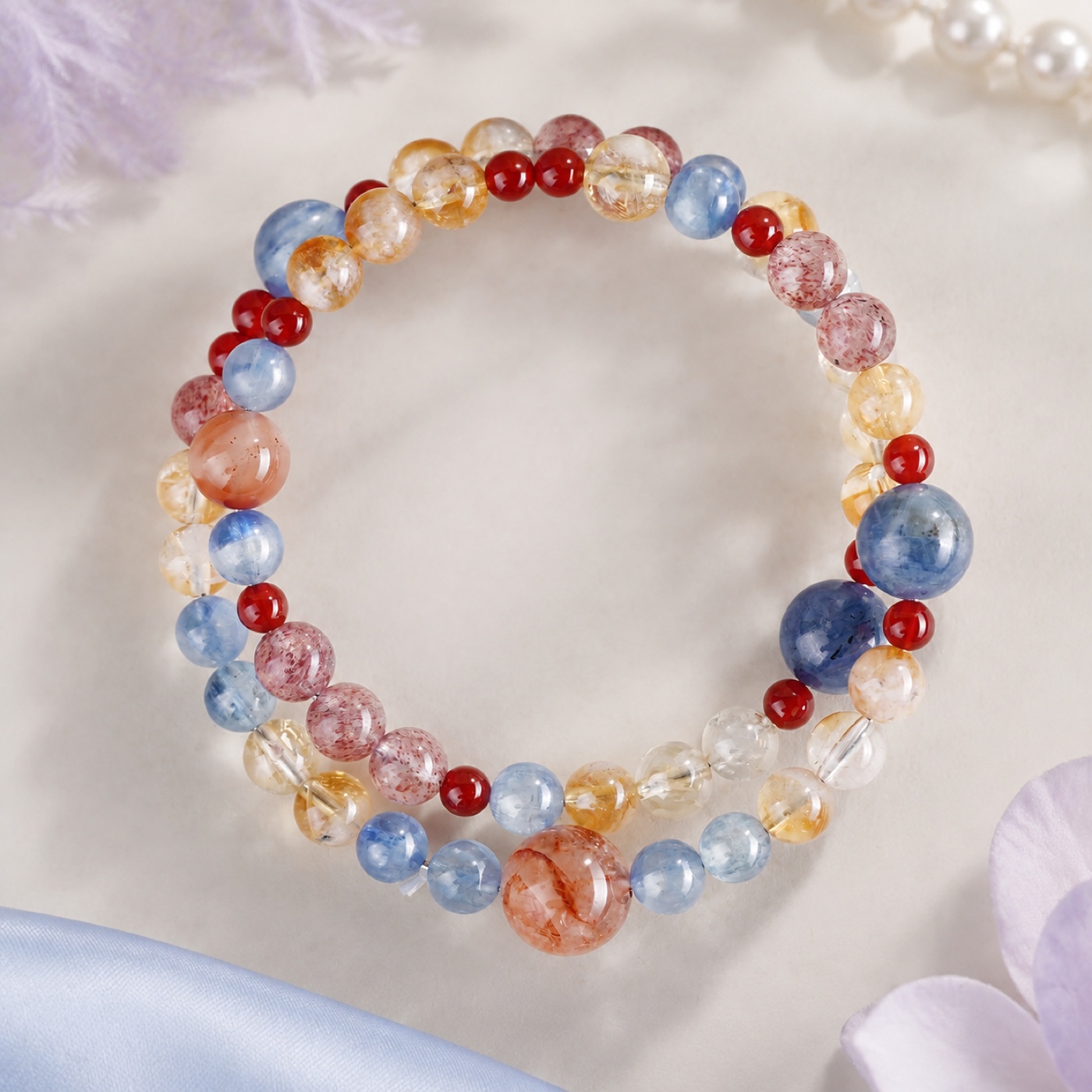
One bead may transmit light easily while the next appears milky or opaque. That can come from a different concentration of inclusions, a darker color zone, or the way the bead was cut. On a multicolor design such as the Chromara Multicolor Double-Strand Bracelet, deliberate changes in color and scale are part of the composition rather than evidence of a mismatched strand.
Natural-looking feature or damage?
What you see
Internal feature
Possible damage
Fine line
Appears enclosed and changes as you rotate the bead
Reaches the surface, catches a fingernail, or has a sharp edge
Cloudy area
Soft-edged patch within the material
Dull, abraded patch on the outside
Mark near a hole
Smooth opening with an internal line behind it
Fresh chip, radiating fracture, or rough material missing from the rim
Different color
Gradual zoning or stable difference under several lights
Surface color appears scratched, concentrated around holes, or transfers to cloth
This comparison is a screening tool, not a gem identification test. If the bracelet is valuable, the material is disputed, or the feature is difficult to interpret, a qualified gemologist can examine it with appropriate instruments.
Pay special attention to drill holes
Drilling concentrates stress in a small area. A tiny irregularity at a bead opening can be harmless, especially when the edge is polished smooth. A widening fracture, missing chip, or sharp rim is different because it may rub against the cord and weaken the bracelet over time.
Gently separate neighboring beads and inspect each opening. Do not pull the elastic hard to create space. If a rough hole is cutting into the cord, stop wearing the bracelet until the bead or stringing material can be checked.
Why it may look different from the product photo
A close-up image can make color and texture differences more visible, but it does not establish the bead material or the physical condition of a specific item unless the seller confirms it is an unaltered photo of that item.
Product photography controls light, background, camera exposure, and color balance. Your screen adds another layer of interpretation. A pale blue bead may look cooler against white, warmer beside skin, and darker in a room with yellow lighting.
Close-up images can exaggerate contrast and make small internal features appear prominent. Before deciding that a bracelet is materially different from the listing, compare it in indirect daylight and review every available product image—not only the most dramatic close-up.
Variation should still fall within what the listing reasonably presents. If the overall palette, bead shape, focal arrangement, or construction is substantially different, ask the seller for clarification while the return window is open.
When to keep wearing it—and when to pause
Usually reasonable to monitor: enclosed clouds, stable color zoning, smooth internal lines, and small differences in clarity.
Ask the seller: an unexpected bead type, unexplained coating, major strand mismatch, or a feature the listing does not help you interpret.
Pause wear: a sharp chip, a crack that reaches the surface, a damaged drill hole, a loose focal element, or cord that is visibly fraying.
If you continue wearing the bracelet, follow the care instructions for its specific materials and construction. When those details are not available, avoid impacts and remove it before activities that could expose the beads, cord, metal, coating, or other components to moisture or chemicals. For a broader routine, see our guide to wearing a crystal bracelet every day.
How variation affects choosing and styling
Differences in bead color, clarity, and pattern can give a design its visual rhythm; appearance alone does not confirm material origin.
Variation is also a design decision. A tightly matched strand feels calm and minimal. A bracelet with visible shifts in tone or clarity feels more organic and can become the focal point of a stack. Neither look is automatically higher quality; the right choice depends on what the seller disclosed and what you want to wear.
Bead scale changes how easily you notice those details. Larger beads reveal more surface and internal pattern, while smaller beads often read first as an overall color rhythm. Our beaded bracelet size guide explains how bead diameter changes visual presence and fit.
If the bracelet contains several colors or strong internal patterns, pair it with one quieter piece rather than adding competing focal points. See how to stack beaded bracelets for a practical color and proportion framework.
A better question than “Is every bead identical?”
Perfect matching is not the only sign of good workmanship, and visible variation is not a universal certificate of authenticity. A more useful standard is whether the bracelet matches its description, the variation feels intentional or reasonably disclosed, the surfaces are well finished, and the construction is sound.
Some differences are part of the material’s appearance, some come from light and photography, and a smaller group signal damage that deserves action. Knowing the difference helps you choose—and wear—your bracelet with more confidence.
Quick questions
Do inclusions mean a crystal bracelet is real?
No single visible inclusion proves identity or natural origin. Internal features can offer clues, but reliable identification may require professional testing.
Is a line inside a bead always a crack?
No. It may be an enclosed inclusion, growth feature, or healed internal fracture. A line that visibly reaches the surface, has a sharp or rough edge, or appears to be spreading from a chip is more concerning, but these observations cannot confirm a crack. When in doubt, pause wear and ask a qualified jeweler or gemologist to examine it.
Should all beads match the product photo exactly?
Not necessarily. Lighting, screens, and material variation can change appearance. The bracelet should still match the listing’s overall palette, construction, and disclosed characteristics.
Ready to compare finished designs? Browse Evara Vale crystal bracelets and review the exact product photos and published details for each piece.
Online product images can help you compare visible design features such as color, bead arrangement, and apparent surface finish. Unless a seller confirms that an image is an unaltered photograph of the specific item, it cannot establish the material, natural or laboratory origin, treatment, or current condition. If those details matter, review written disclosure and ask for current, unaltered close-up photos; for higher-value purchases, consider independent gemological testing.
This guide explains how to tell if a crystal bracelet is real without relying on viral “one-test” claims. It also shows how to judge workmanship and overall quality before you buy.
First, what does “real crystal” mean?
Before judging a bracelet, separate four different questions:
Natural: the material formed in nature.
Lab-grown or synthetic: material made in a laboratory with essentially the same chemical and physical properties as its natural counterpart.
Imitation or simulant: a different material chosen to resemble another gem.
Treated: natural or laboratory-grown material whose color or appearance has been altered or improved.
These categories are not interchangeable. A synthetic gem is not the same thing as a glass imitation, while a natural stone may still have been dyed, heated, filled, coated, or otherwise treated. The most useful question is therefore not simply “Is it real?” but “What exactly is the material, and has it been treated?”
What product images can and cannot show
1. Whether variation looks natural and coherent
Materials can vary in tone, translucency, inclusions, banding, or cloudiness. A bracelet does not need every bead to look identical to be well made. Thoughtful matching can make beads feel visually cohesive while retaining individual differences, but an image alone cannot establish the material or origin.
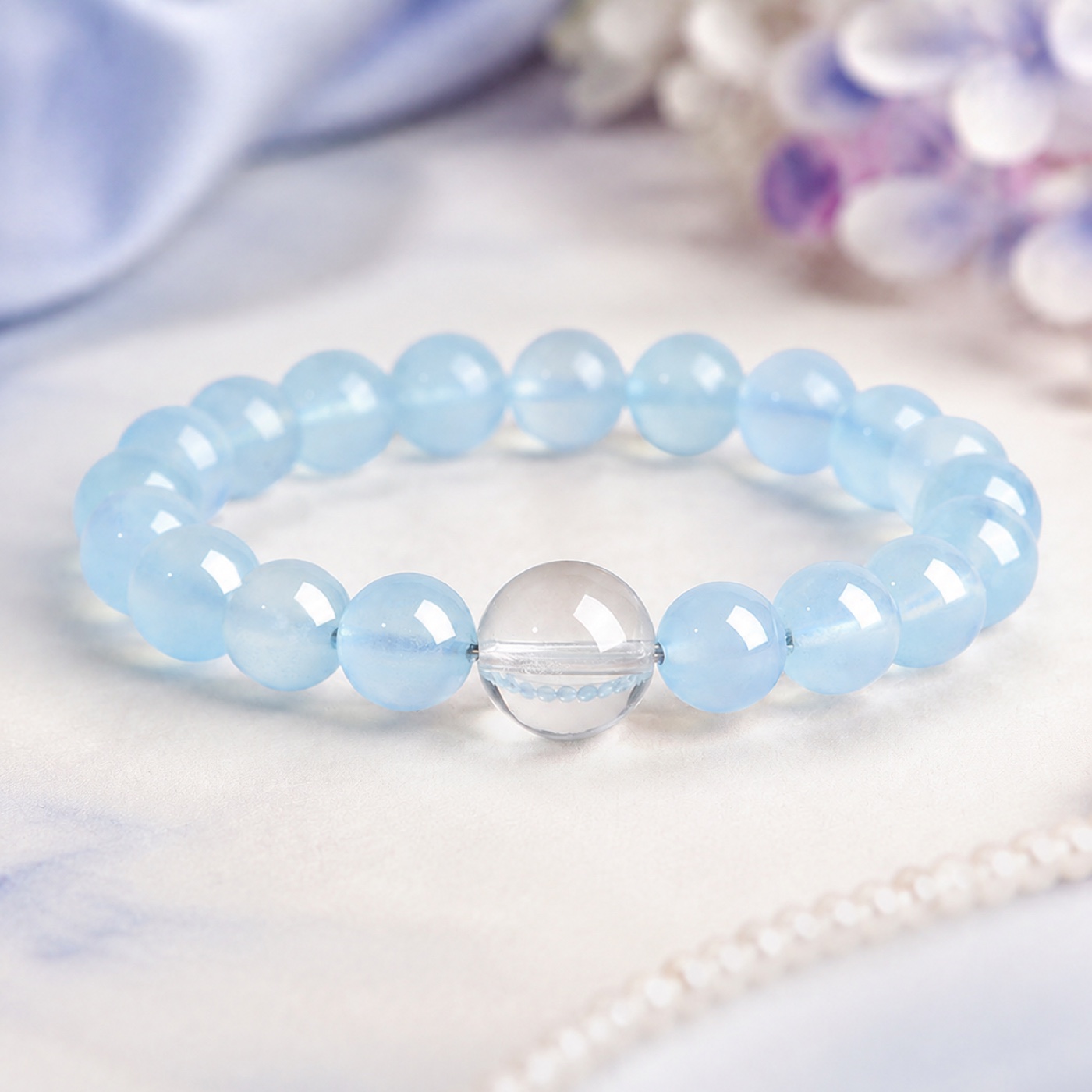
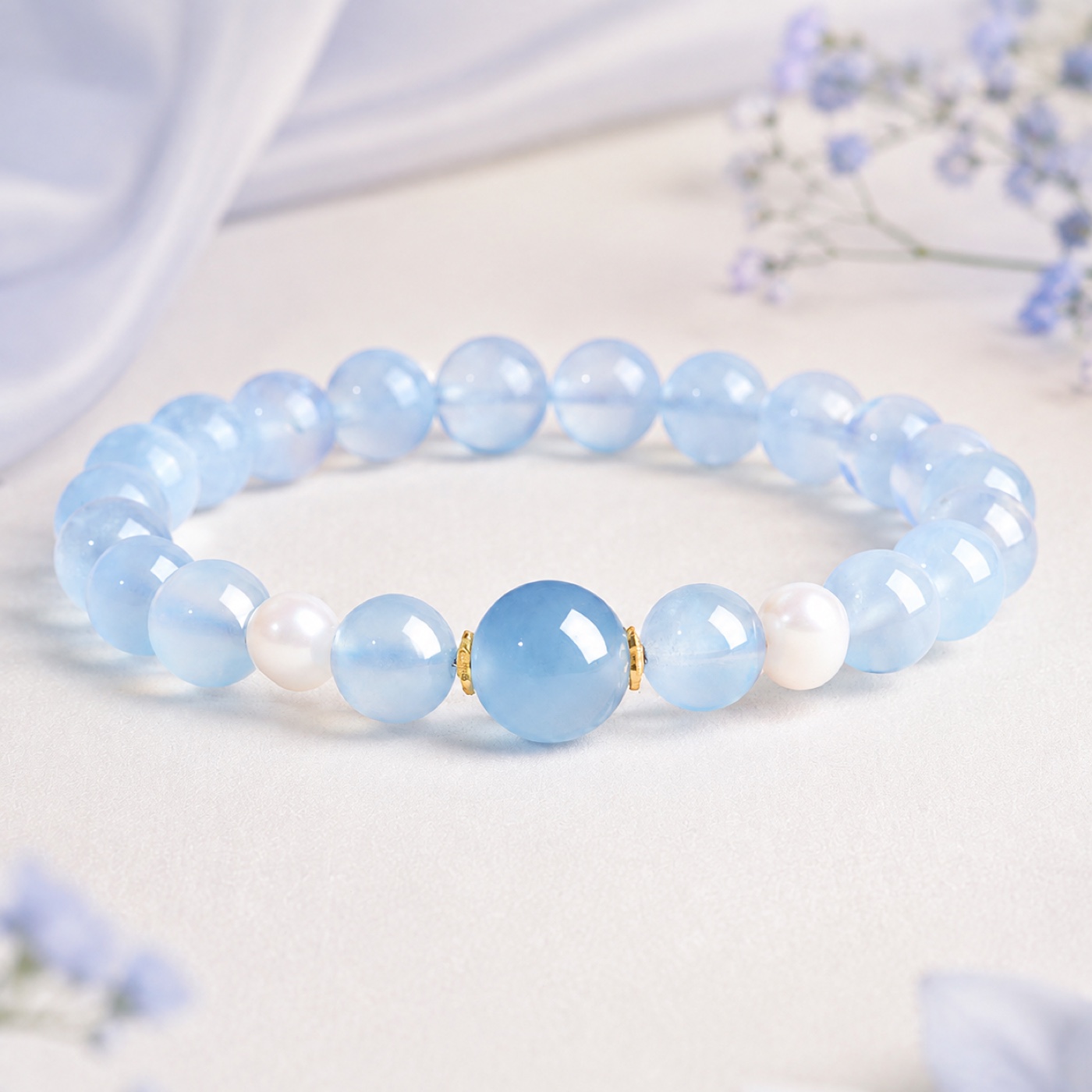
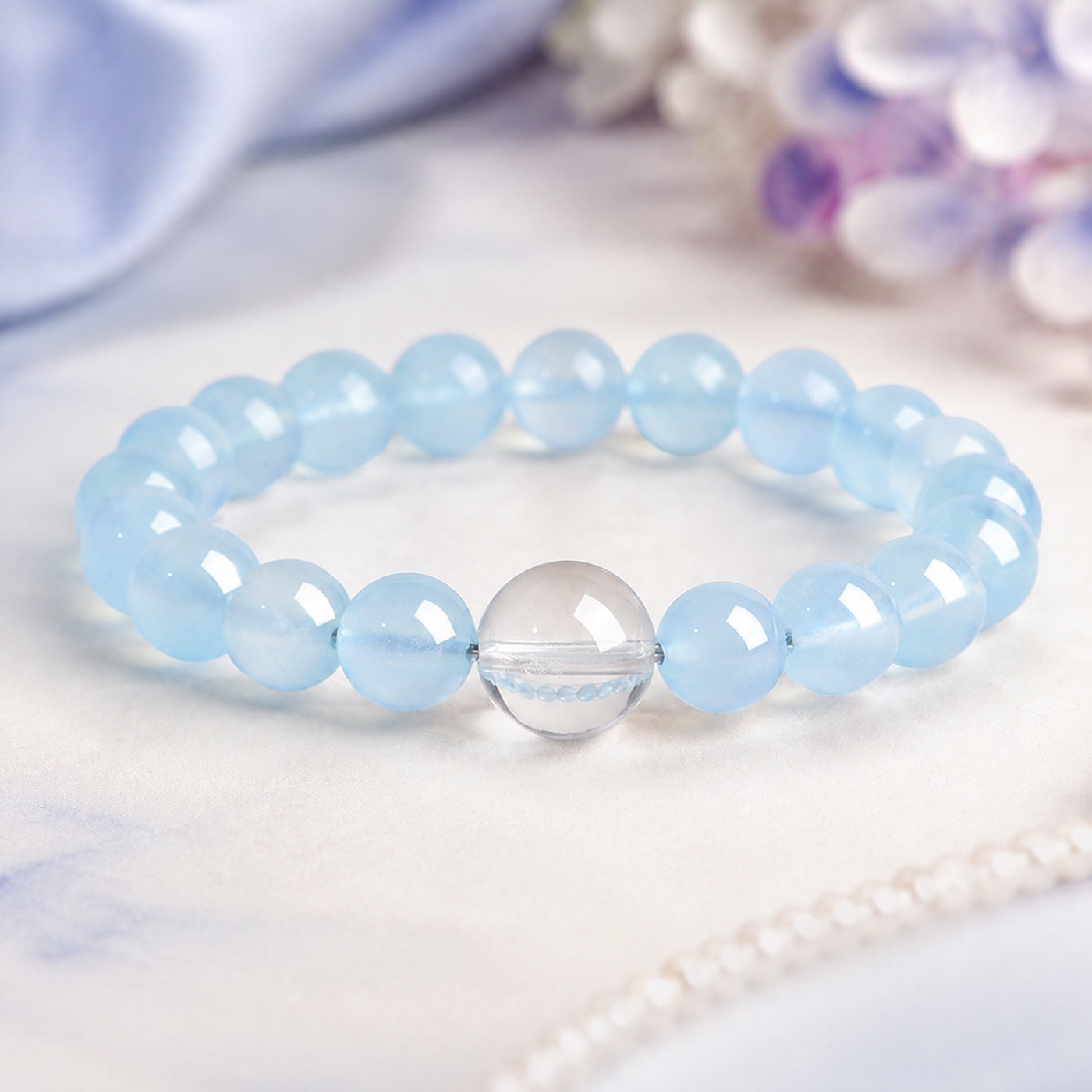
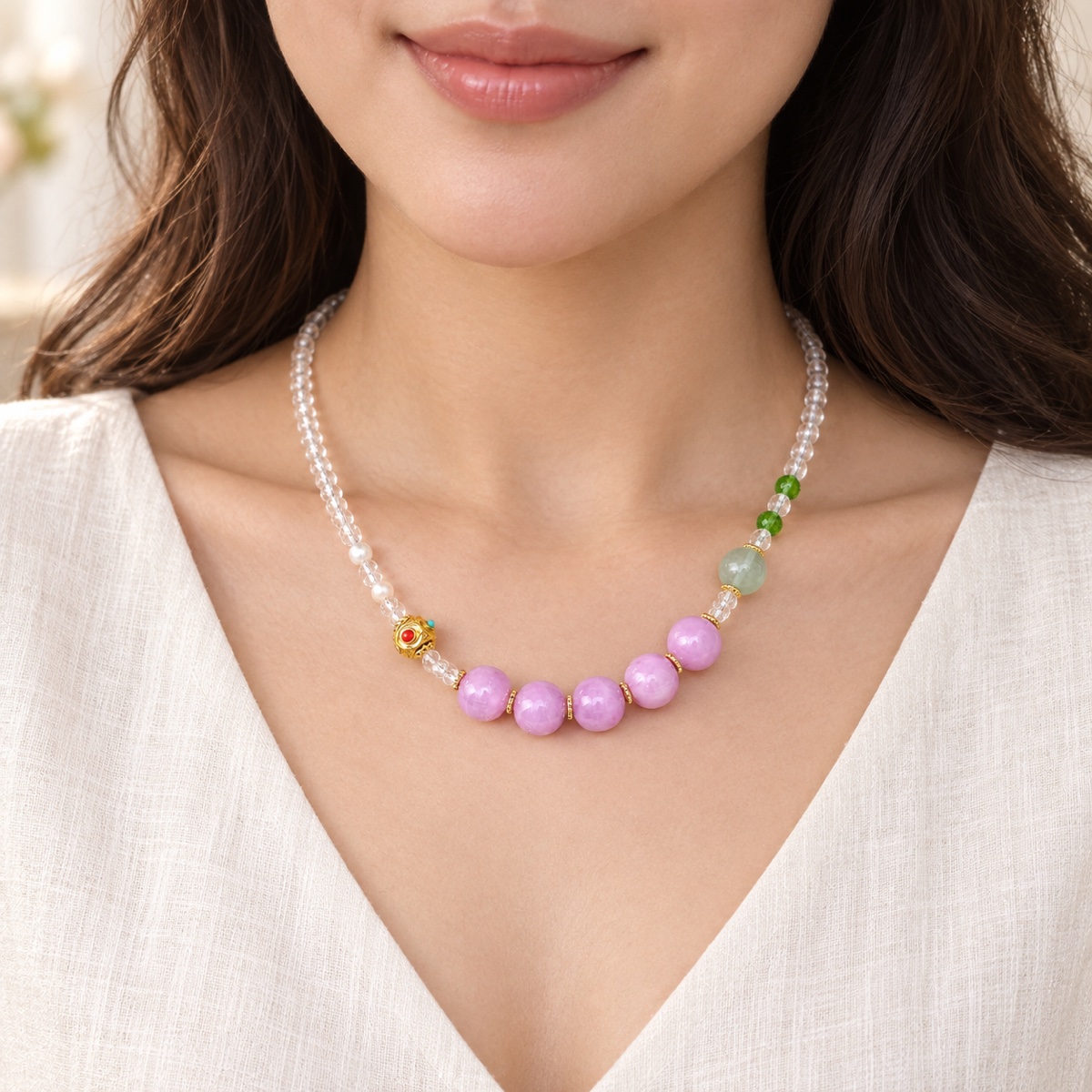
This image shows the Aqualume design’s overall bead arrangement and focal bead. It does not verify material identity, internal features, polish, or the condition of a specific item; ask the seller for current, unaltered close-ups when those details matter.
Look at the full bracelet rather than one dramatic close-up. Ask whether the bead sequence feels intentional and whether the seller provides enough views to inspect the piece as a whole.
2. Drill holes, polish, and surface finish
Zoom in on the holes and edges. Clean drilling, smooth transitions around the holes, even polish, and minimal chipping are signs of careful finishing. Minor natural texture or internal features do not automatically indicate poor quality; rough edges, obvious cracks extending from drill holes, or careless abrasion are more concerning.
3. Construction and alignment
When a listing provides unaltered photographs of the specific item, close views may help you ask informed questions about strand alignment and component placement. Representative or digitally styled images can show a design, but cannot verify the physical finish or condition of the item you receive.
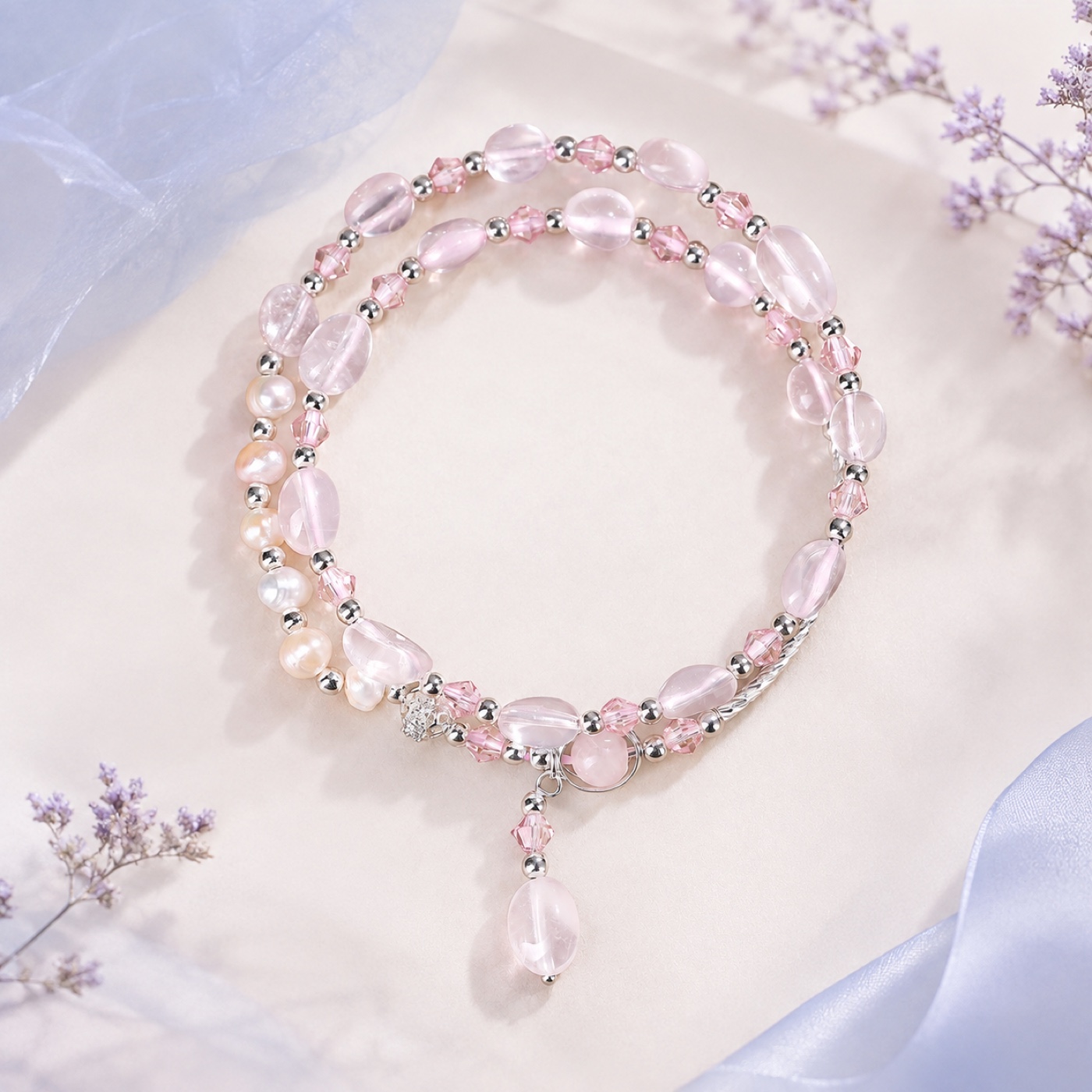
The Roselight image illustrates a double-strand layout and focal details. It is a design reference, not independent evidence of material identity, bead matching, or physical finish.
What photos cannot prove
A beautiful image cannot reliably establish mineral identity. Lighting, white balance, editing, screen settings, and background color can all change how a stone appears. Nor can a photograph conclusively prove that a stone is untreated or distinguish every natural material from a sophisticated synthetic or imitation.
Be cautious when a seller treats visual clues as absolute proof. Bubbles, inclusions, temperature, weight, or color zoning may be useful observations in context, but none is a universal verdict for every gem material.
Authenticity and quality are different
Question
What it concerns
Best evidence
Is the material correctly identified?
Authenticity
Accurate disclosure; testing when necessary
Has it been treated?
Disclosure
Seller information; laboratory report for higher-stakes purchases
Is it well finished?
Craftsmanship
Clear photos of polish, drilling, components, and construction
Does the bracelet look harmonious?
Design quality
Full-bracelet views and consistent product photography
A bracelet can contain natural material and still be poorly drilled or assembled. Conversely, a well-made bracelet may use laboratory-grown or imitation material that is honestly disclosed. Good buying decisions depend on both accurate identity and good craftsmanship.
How to judge a high-quality crystal bracelet
Intentional color selection
Good matching is not the same as perfect uniformity. Look for a balanced progression of hues, a clear focal point, or a deliberate contrast. Multicolor pieces should still feel composed rather than random.
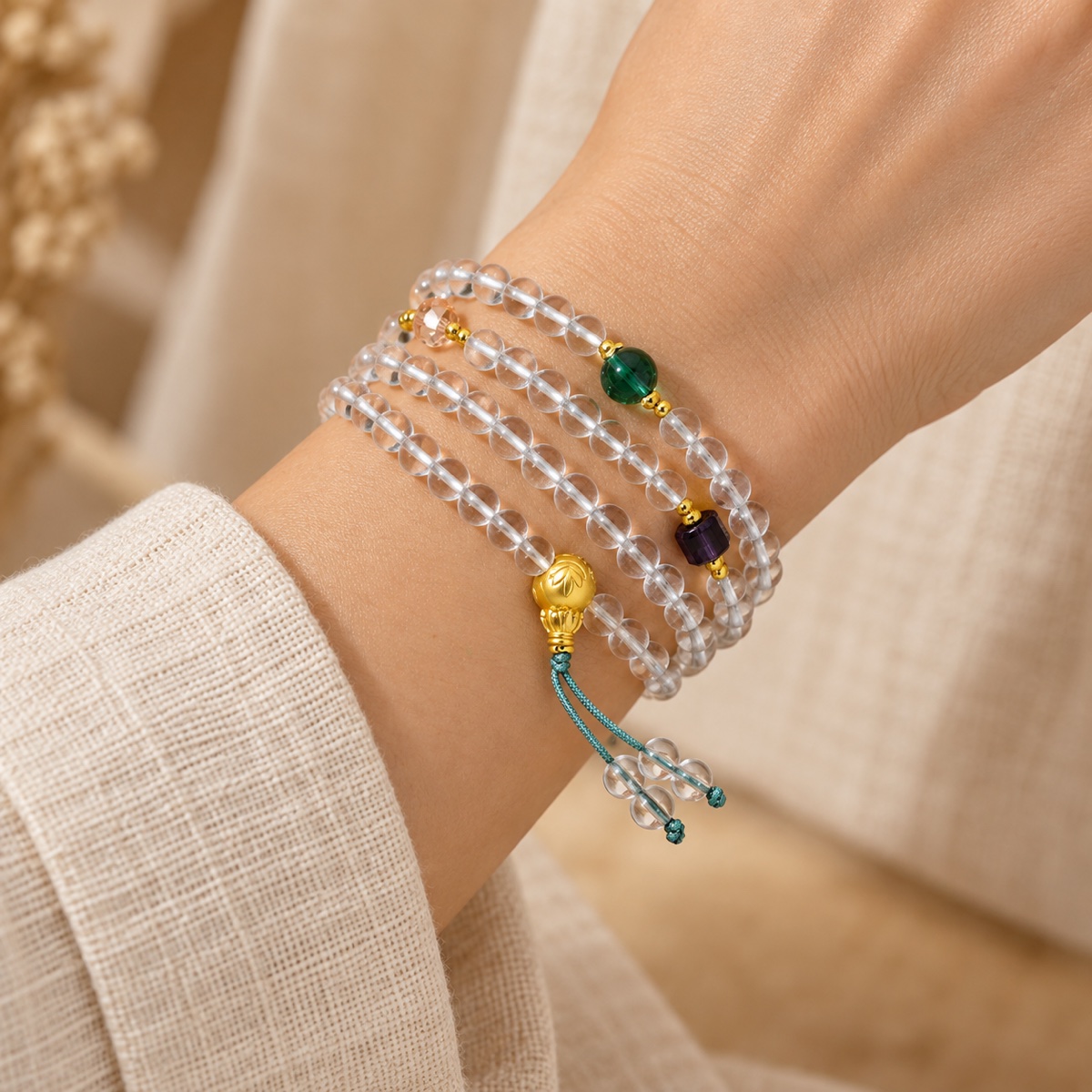
This product image illustrates the contrasting focal color and double-wrap layout; it cannot establish the material or the condition of a specific bracelet.
Consistent polish and careful drilling
Inspect several beads, not only the best-looking one. Surface reflections should be reasonably clean and consistent. Drill holes should not appear jagged, heavily chipped, or placed so poorly that the beads sit awkwardly.
Balanced construction
Check symmetry, strand spacing, charm placement, and how the bracelet is likely to sit on the wrist. For sizing guidance, read our beaded bracelet size and fit guide.
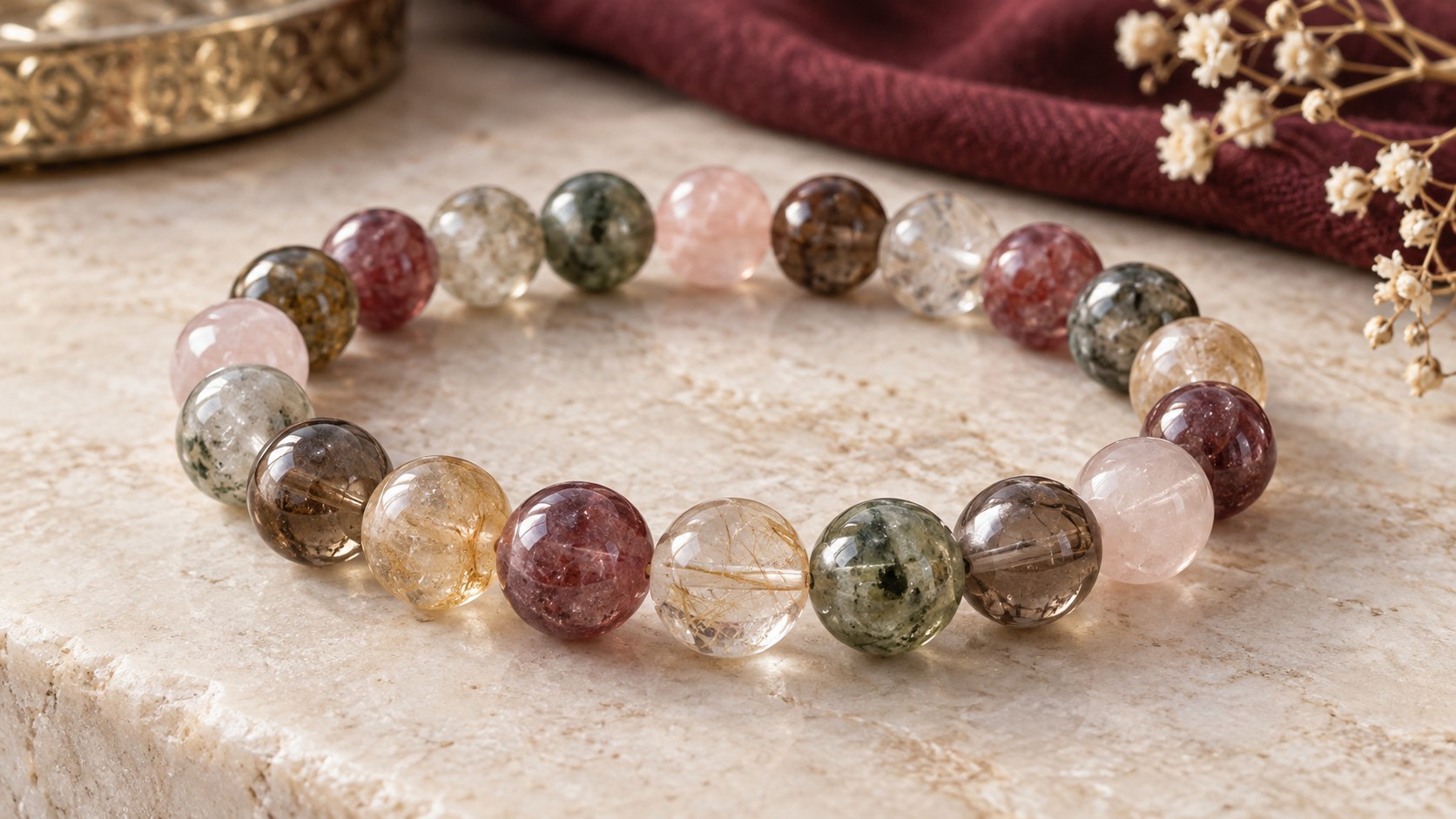
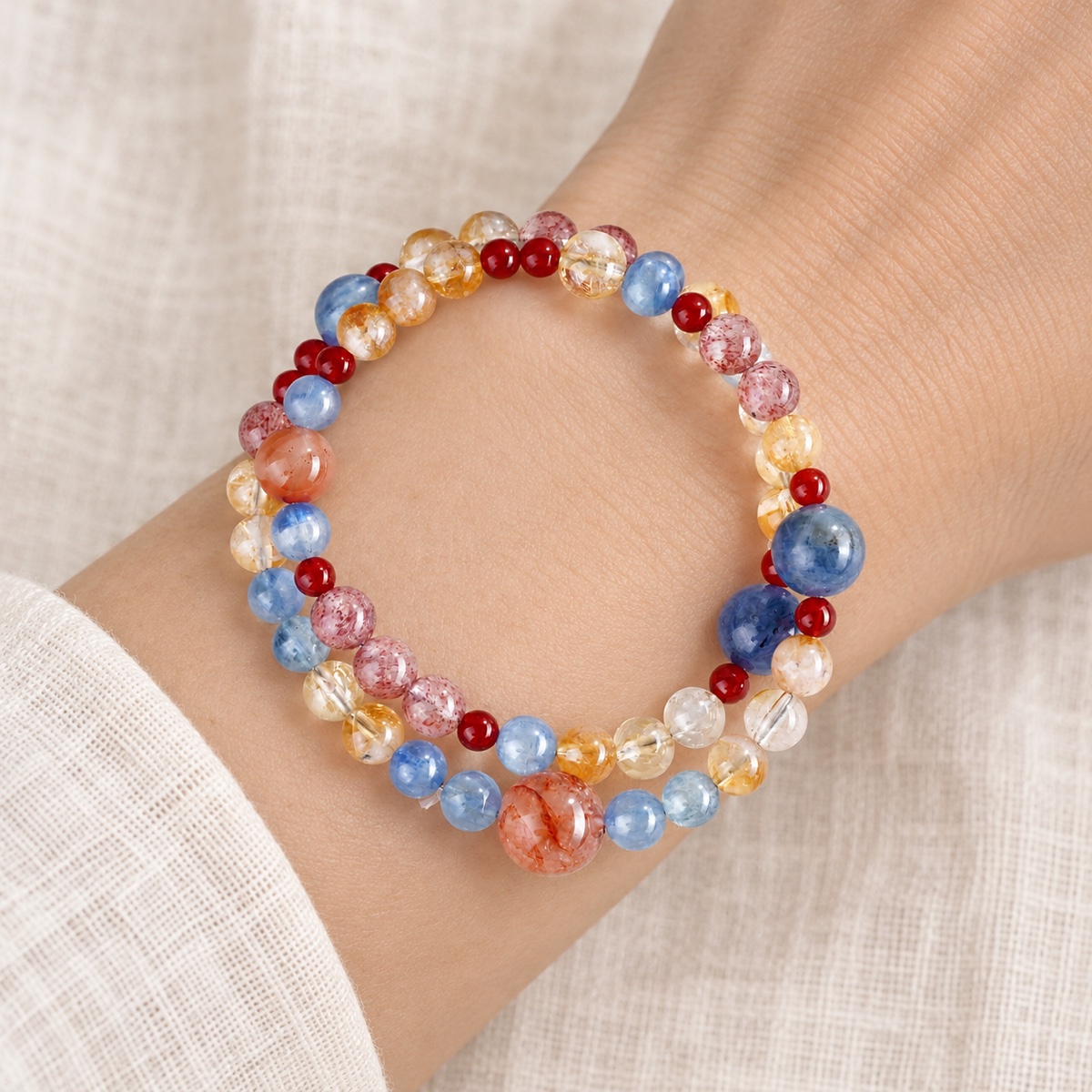
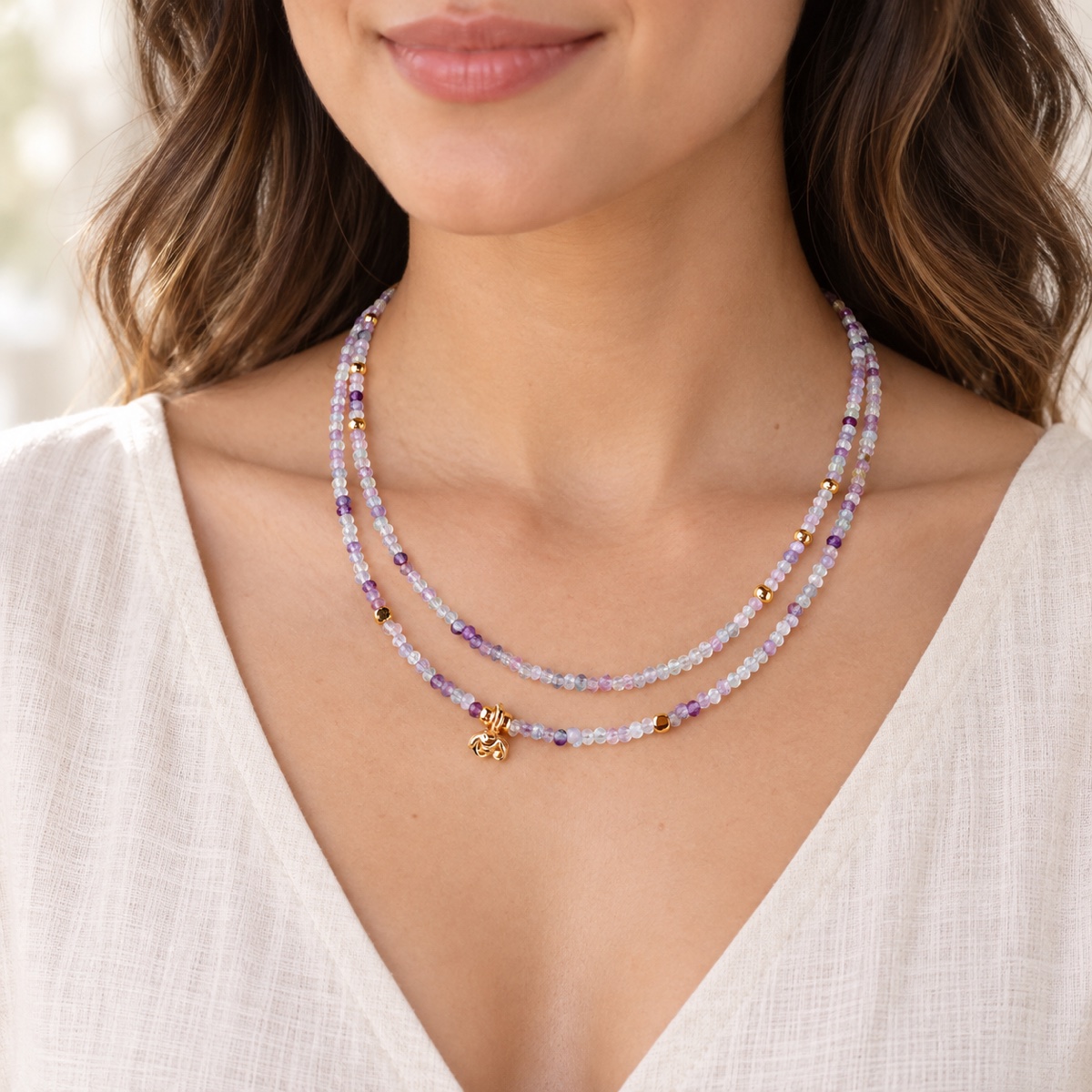
This image illustrates the multicolor, double-strand design. For actual finish or condition, rely on current, unaltered photographs of the specific item and written seller disclosure.
Home checks: useful observations, not final proof
Inspect under neutral light
View the bracelet in daylight or neutral indoor light and compare it with the seller’s photos. Strong differences do not automatically prove a problem, but they are a reason to ask questions about editing, lighting, or treatment.
Use a loupe carefully
A 10× loupe may reveal surface wear, chips, drill-hole condition, bubbles, growth features, or inclusions. Interpretation is material-specific, however. Seeing an inclusion does not by itself prove natural origin, and not seeing one does not prove the opposite.
Compare weight and temperature only as supporting clues
Glass, stone, resin, and different minerals can feel different, but bead size, hollow components, room temperature, and handling time affect the result. The popular “cold to the touch” test is not a reliable stand-alone identification method.
Avoid destructive tests
Scratch tests, flame tests, chemicals, and impact tests can damage beads, coatings, elastic, finishes, or metal components. They may also be misinterpreted. For a finished bracelet, destructive internet tests are rarely worth the risk.
Seller disclosure matters more than a viral trick
A responsible listing should identify the material clearly and avoid implying that appearance alone proves origin. Treatment information should be disclosed when it affects value or care. The U.S. Federal Trade Commission advises buyers to ask whether gemstones are natural, laboratory-created, or imitation and whether treatments require special care.
Material information varies by design, so review the specific product listing rather than inferring composition from color or photographs. The crystal guide offers general background; for a detail about one design, ask the seller to confirm it before purchase.
Questions to ask before buying
What is the stated material for every main bead and component?
Is the material natural, laboratory-grown, or imitation?
Are any stones dyed, coated, heated, filled, stabilized, or otherwise treated?
Are the photos of the actual item or a representative sample?
What is the bead size and bracelet fit?
What is the return policy if the item differs materially from its description?
Is independent testing available for a higher-value purchase?
When a laboratory report is worth considering
For an everyday beaded bracelet, independent testing may cost more than the item and may not be practical. A report becomes more relevant when the stone identity materially affects price, the seller makes unusual rarity claims, the item is high value, or you need certainty for insurance, resale, or collecting.
A laboratory report identifies the tested specimen and may describe whether it is natural or laboratory-grown and whether detectable treatments are present. It is not the same as an appraisal and does not automatically assign monetary value.
A practical buying checklist
Read the full material description, not just the product title.
Look for multiple clear, consistent photographs.
Inspect bead variation, polish, drill holes, and construction.
Treat home tests as clues, never universal proof.
Avoid destructive testing on finished jewelry.
Ask direct questions about origin and treatment.
Check sizing, care instructions, and the return policy.
Consider laboratory testing only when the value or claim justifies it.
Can you tell whether a crystal bracelet is real from a photo?
You can assess visible quality and notice clues, but a photo alone cannot conclusively establish material identity, natural origin, or treatment status.
Do bubbles mean a bead is fake?
Sometimes bubbles can suggest glass, but interpreting internal features depends on the material and manufacturing process. One observation is not universal proof.
Does a real crystal always feel cold?
No. Temperature is affected by the material, room conditions, bead size, and how long it has been handled. Use it only as a limited supporting observation.
Are perfectly uniform beads fake?
Not necessarily. Careful sorting can produce a uniform strand, and some natural materials are more consistent than others. Uniformity alone does not identify origin.
What is the safest way to verify a valuable stone?
Start with written seller disclosure. When identity significantly affects value, use a qualified independent gemological laboratory rather than a destructive home test.
Can you wear a crystal bracelet every day? Yes—if its fit, comfort, and care suit your routine. Learn when to take it off.
A bracelet that looks beautiful in a product photo still needs to work when you type, pull on a sleeve, carry a bag, or wear a watch. Here is how to decide whether you will enjoy reaching for it regularly.
Think about your day, not just your outfit
Start with the moments when you will actually notice a bracelet on your wrist.
At a desk, rest your hand where it normally sits while you type. If the beads press against the desk edge, try the other wrist or consider whether you would prefer to take the bracelet off during work. Under a fitted cuff, check whether the bracelet slides comfortably beneath the fabric or catches when you move your arm.
Notice where the bracelet sits next to a sleeve, then consider how it would feel during your own day.
If you wear a watch, you do not have to place both pieces on the same wrist. Try them together, then try one on each wrist. The arrangement that looks best in a photograph may not be the one you find most comfortable by the end of the day. For more ways to arrange multiple pieces, see our guide to stacking beaded bracelets.
These small tests tell you more about everyday wear than a rule about which wrist you should use.
Choose a design you can picture wearing often
Color matters, but the bracelet’s shape changes how it fits into an outfit. A single strand creates one clear line around the wrist. A double strand has a more layered appearance even when worn on its own.
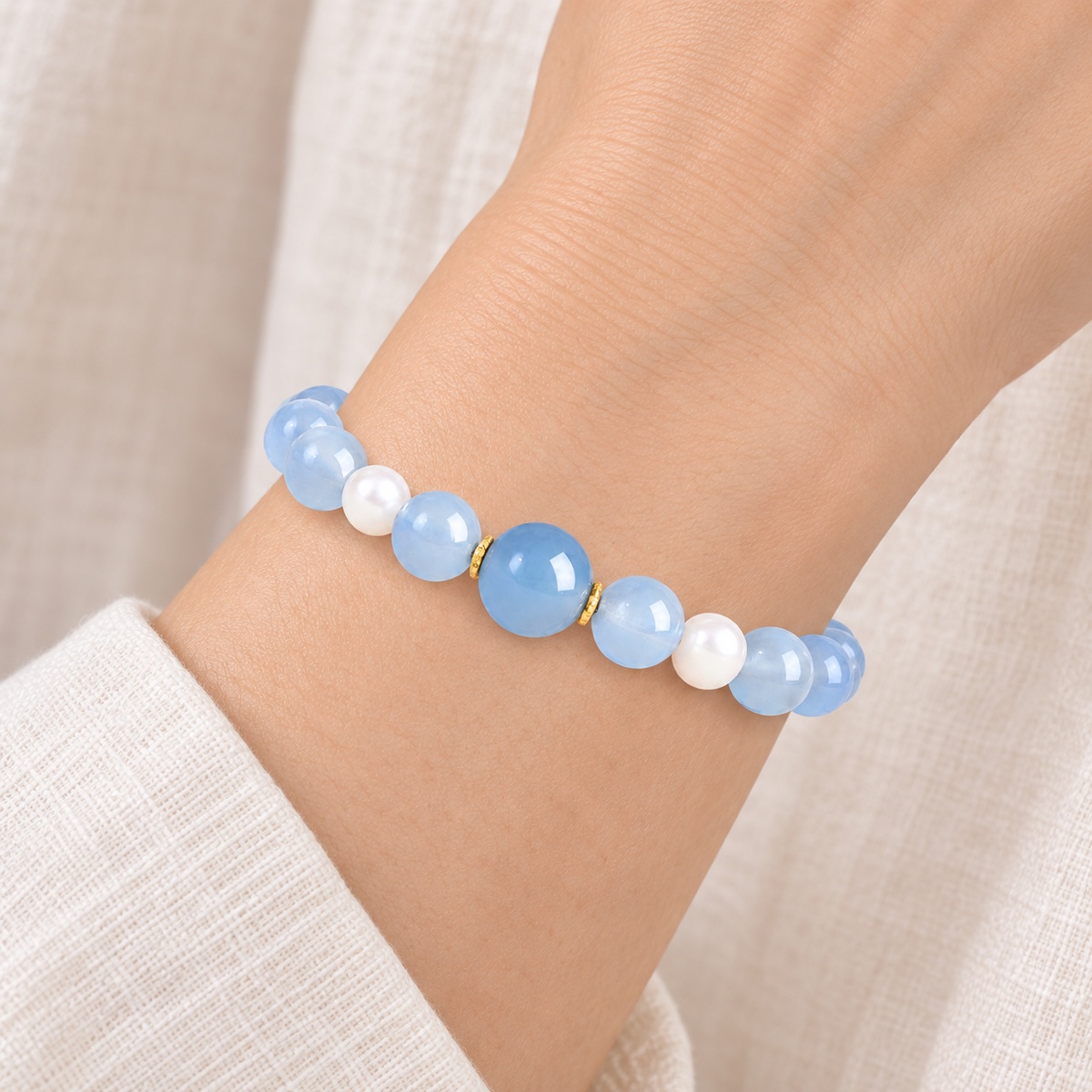
For example, the Aqualume Blue Focal Bracelet — 8 mm is a single-strand stretch design with pale-blue beads and a centered focal detail. The Chromara Multicolor Double-Strand Bracelet has two strands and a mix of colors. Neither style is automatically the “everyday” choice: one may suit a quieter look, while the other may appeal to someone who wants the bracelet to be the main detail.
A double-strand design creates a layered look without adding a separate bracelet.
Before choosing from a close-up image, look at the complete bracelet and consider what you normally wear. If you usually reach for one understated accessory, begin there. If you enjoy visible color and layering, a fuller design may feel more like you.
Everyday wear still includes taking it off
Make removal part of the routine rather than waiting until a bracelet gets in the way. Evara Vale’s jewelry-care guidance recommends putting jewelry on after fragrance and lotion, and removing it before bathing, swimming, cleaning, or exercise. Keep it dry, wipe it gently with a soft cloth, and store it separately when it is not being worn.
You can enjoy the same bracelet on many ordinary days while still giving it a safe place to rest during a shower, workout, or household cleaning. If the bracelet can press against your wrist, catch on bedding, or stretch while you sleep, place it in its storage spot before bed. That is more practical than treating “everyday” as a promise that a piece never needs to come off.
Check the fit before you order
A stretch bracelet still needs to fit the wrist comfortably. Stretch helps it pass over your hand; it does not make every finished size suitable for every person.
Measure where you intend to wear the bracelet, then check how the product’s fit is described. If a recommended wrist range is not clear, ask before ordering. Our beaded bracelet size guide explains the difference between bead diameter and bracelet fit—two details that are easy to confuse when shopping online.
Also check the construction and care details on the exact product page. A photo can show you the design, but it cannot tell you everything about how a bracelet will feel during your day.
Find the version of “everyday” that works for you
The easiest bracelet to wear regularly is not necessarily the smallest, palest, or simplest one. It is the piece you like enough to put on, that sits comfortably in your routine, and that you are willing to care for properly.
Choose the look first, confirm the fit, and think through the ordinary parts of your day. Then wear it when it works—and take it off when it does not.
When you are ready to compare colors, silhouettes, and strand styles, explore the crystal bracelet collection and choose the design that fits the way you actually dress and move.
A bracelet can feel personal without being easy to size. If you want the gift to remain a surprise, the safest approach is not to guess a “standard” wrist measurement. Start with evidence the recipient has already given you: a bracelet they wear, the jewelry proportions they prefer, and the way they use their hands throughout the day.
Then check how the new bracelet is constructed and how the seller defines its size. Stretch, wrap, clasped, and fixed-shape bracelets do not fit in the same way—and none should be treated as universally sized without details from the product listing.
Here is how to choose thoughtfully while keeping the sizing risk under control.
Start with a bracelet they already wear
An existing bracelet is usually your most useful clue, but only if the recipient wears it comfortably.
Look for a piece they choose often rather than one that sits untouched in a jewelry box. Notice where it rests, how much it moves, and whether it closes with a clasp, stretches over the hand, or wraps around the wrist.
If you can borrow it briefly, check how the seller of the new bracelet asks customers to measure. Depending on the design, that might mean:
Measuring the total length from end to end
Measuring between usable clasp points
Measuring the inside circumference
Measuring the diameter of a rigid bangle
Recording the wrist size for which the bracelet is recommended
These measurements are not interchangeable. A beaded bracelet’s outside length, for example, does not necessarily describe the usable space inside the loop. Larger beads can reduce that interior space.
If the new product page does not explain what its stated size represents, ask the seller before ordering.
Use a bracelet the recipient already wears as a sizing clue.
Use discreet clues, not body-size assumptions
Clothing size, height, weight, and ring size do not reliably tell you someone’s wrist measurement. A visual guess can also be misleading, especially when you are comparing your wrist with theirs from memory.
Better clues include:
A watch strap they wear regularly
A bracelet they already find comfortable
A recent photo showing whether their jewelry fits closely or moves freely
A friend or family member who can ask naturally
A casual conversation about jewelry sizing while shopping together
A watch can help you understand how close or loose the recipient likes wrist accessories, but it may not translate directly to a beaded bracelet. Treat it as a preference clue rather than an exact measurement.
If you cannot find a dependable reference, asking is better than turning a meaningful gift into an uncomfortable one. You can preserve some of the surprise by revealing the category—not the exact design—and asking for a wrist measurement.
Check the bracelet’s construction before deciding
Construction affects how much sizing uncertainty a bracelet can tolerate.
Bracelet construction
What to verify before buying
Important caution
Stretch bracelet
Recommended wrist range, inside fit, bead size and elastic construction
Stretch helps the bracelet pass over the hand; it does not make every size comfortable
Clasped bracelet
Finished length, usable clasp points and whether an extension is included
Do not assume a visible chain is adjustable unless the listing says so
Wrap bracelet
Total length, number of wraps and closure method
“Wrap” describes the silhouette, not automatically an adjustable fit
Rigid bangle
Interior diameter and required hand measurement
Wrist circumference alone may not establish whether it will pass over the hand
Open cuff
Interior dimensions and adjustment guidance
Repeated bending may damage some cuffs; follow the maker’s instructions
The best gift option is the one whose actual sizing information matches the evidence you have. A theoretically flexible design is not helpful if the product page never states its usable range.
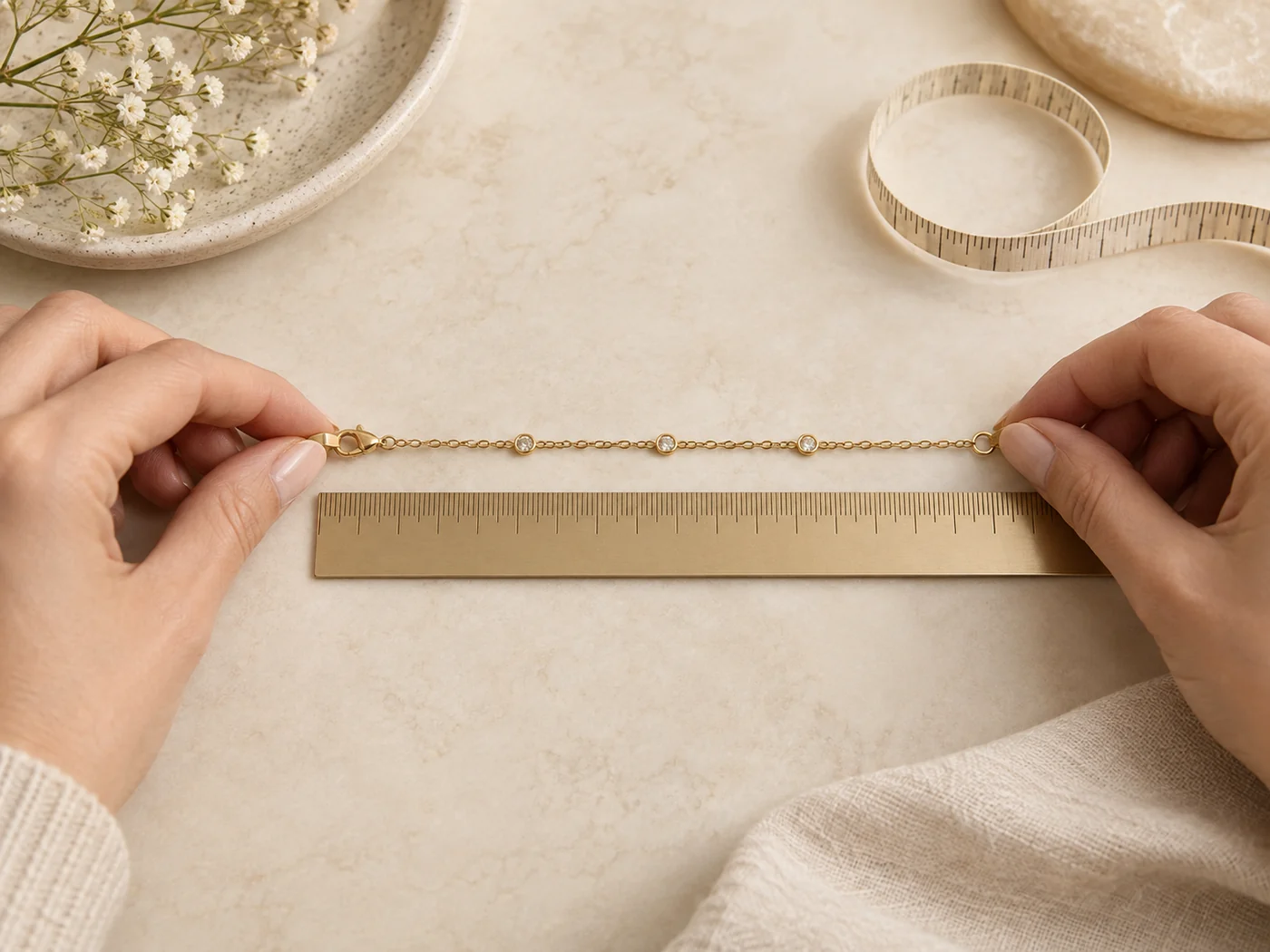
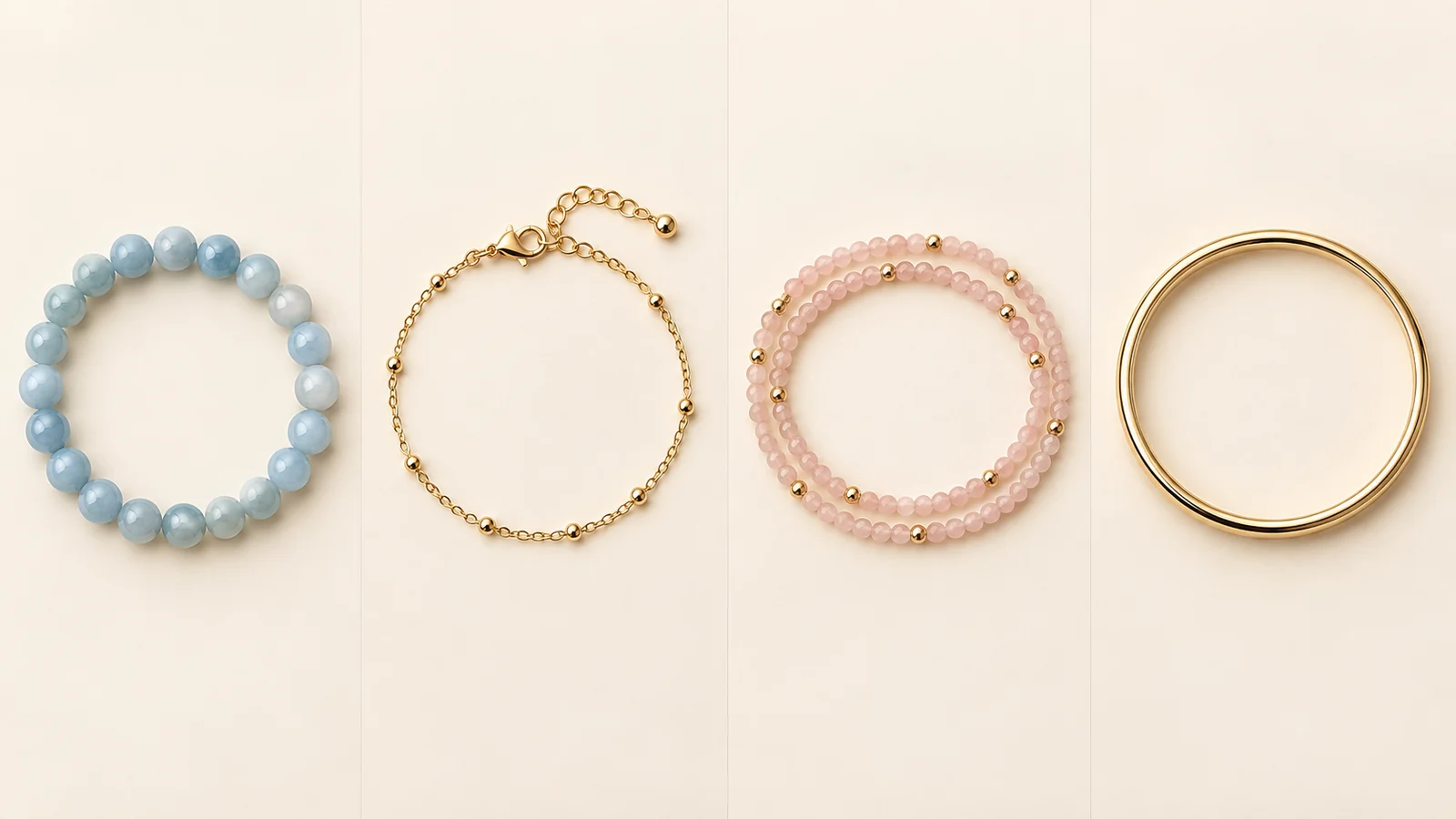
Illustrative comparison of four common bracelet constructions.
Separate bead size from bracelet fit
On beaded jewelry, a measurement such as 6 mm, 8 mm, or 10 mm often refers to the diameter of an individual bead—not the wrist size.
Bead diameter changes the visual presence of the bracelet. Smaller beads tend to create a finer line around the wrist, while larger beads create a fuller silhouette. Neither automatically indicates whether the finished bracelet will fit the recipient.
When giving a bracelet, consider both questions separately:
Will the finished bracelet fit comfortably?
Will the bead proportion suit the recipient’s style?
A correct fit can still feel wrong if the design is much bolder or more delicate than anything the recipient normally wears.
Let their current jewelry reveal their style
You do not need to know someone’s favorite gemstone to choose a thoughtful bracelet. Their existing jewelry can tell you a great deal.
Look at visual scale
Does the recipient wear fine chains and small earrings, or do they prefer substantial watches and statement pieces?
A quieter bracelet may suit someone who keeps accessories subtle. A larger focal bead, multi-strand design, or pendant detail may be more appropriate for someone who treats jewelry as the center of an outfit.
Notice their color palette
Look at the clothes and accessories they reach for most often.
Soft pink, pale blue, clear and neutral tones can sit easily with light wardrobes.
Violet, amber or multicolor designs create a more defined focal point.
Repeated gold-tone or silver-tone details may help the new piece relate to jewelry they already own.
You do not need an exact color match. A shared undertone or repeated metal color is often enough to make a new bracelet feel familiar.
Observe whether they layer jewelry
Someone who regularly wears a watch or several bracelets may appreciate a narrower supporting strand. Someone who usually wears one wrist accessory may prefer a piece with a clear focal detail.
If they enjoy layered looks, Evara Vale’s guide to stacking beaded bracelets can help you judge color, bead scale and everyday comfort.
Pay attention to their routine
A bracelet should suit the recipient’s day as well as their style.
For someone who types frequently, a very loose bracelet or prominent charm may press against the desk. Delicate knitwear can also catch on exposed fittings. Someone who prefers fitted sleeves may be happier with a narrower silhouette than a broad stack.
These practical details often determine whether a gift becomes an everyday piece or something worn only occasionally.
Choose meaning without making promises
A thoughtful jewelry gift can mark a birthday, a new beginning, a friendship or a memory without requiring a dramatic story.
You might choose:
A color that reminds you of a shared place
A design that echoes jewelry they already love
A focal detail that feels connected to the occasion
A stone traditionally associated with a quality they value
A bracelet that complements a piece they already wear
When referring to crystal symbolism, keep the language personal and grounded. Gemstones may carry traditional or cultural associations, but a bracelet should not be presented as a treatment or as a guarantee of a particular outcome.
Color, craftsmanship, memory and the recipient’s own interpretation are meaningful reasons to choose a piece.
Make the product listing pass a gift test
Before ordering, confirm the details that photographs cannot establish.
Sizing
Look for a recommended wrist range and an explanation of how the bracelet was measured. If only a bead diameter appears, the listing has not necessarily answered the fit question.
Construction
Confirm whether the piece is stretch, clasped, adjustable, wrapped or rigid. Do not infer the construction from a close-up image.
Materials and metal details
Read the stated material information, especially if the recipient has known sensitivities. Color alone cannot identify a gemstone, treatment or metal composition.
Natural visual variation
Natural stone jewelry may vary in tone, clarity, pattern or visible inclusions. Review the seller’s disclosure so you understand whether the photographed piece is exact or representative. Evara Vale’s Crystal Guide explains how visible variation can appear in gemstone jewelry.
Delivery timing
Leave enough time for processing and delivery, especially around birthdays and holidays. A rushed order gives you less room to clarify sizing or inspect the piece before giving it.
Returns and exchanges
Read the current return policy before ordering. Keep the bracelet unworn and retain its original packaging until the recipient has checked the fit.
A clear return path does not make sizing irrelevant, but it makes an honest mismatch easier to resolve.
When should you stop guessing?
Pause the purchase when:
The listing does not define the bracelet size
You cannot tell whether a measurement describes the beads or the finished piece
The recipient has mentioned difficulty finding bracelets that fit
The design is fixed-size and you have no reliable reference
The seller cannot explain the recommended wrist range
The item cannot be returned or exchanged
At that point, ask for the measurement or involve the recipient in the final choice. A partially revealed surprise is better than jewelry they cannot comfortably wear.
A simple bracelet-gift checklist
Before placing the order, make sure you can answer these questions:
Do I have a real clue about the recipient’s wrist or current bracelet fit?
Do I understand how this product’s size is defined?
Have I separated bead diameter from finished bracelet fit?
Does the construction allow the amount of flexibility I expect?
Does the design match the recipient’s usual visual scale and colors?
Have I checked materials, delivery timing and current return terms?
Am I comfortable asking instead of guessing if the evidence is weak?
Once those questions are settled, the enjoyable part remains: choosing the color, silhouette and detail that make the bracelet feel like it belongs to them.
Explore Evara Vale crystal bracelets and compare each piece’s stated construction and dimensions before choosing your gift.
Frequently Asked Questions
Are stretch bracelets one size fits all?
No. Stretch allows a bracelet to pass over the hand, but the finished loop still needs to sit comfortably around the wrist. Check the recommended wrist range rather than relying on stretch alone.
Can I measure one of their existing bracelets?
Yes, provided it is a bracelet they wear comfortably and you measure it in the way the new seller requests. A clasped chain, stretch-bead bracelet and rigid bangle may require different measurements.
Should I choose a larger bracelet if I am unsure?
Not automatically. A bracelet that is too loose can travel toward the hand, rotate, catch on clothing or interfere with desk work. Use the product’s sizing guidance or ask the seller for help.
What if I cannot find any sizing information?
Contact the seller before ordering. If the size still cannot be explained, choose another design or ask the recipient for their wrist measurement.
Is it acceptable to ask and spoil the surprise?
Yes. You can ask for a wrist measurement without revealing the exact bracelet. Comfort matters more than preserving every part of the surprise.
If you are still deciding, our crystal bracelets collection is the widest starting point, and convertible jewelry works when you want one gift to cover more than one way of wearing it. Stretch and double-wrap constructions such as this double-wrap design are the ones least dependent on an exact measurement.
For the same reason, a simple stretch design such as this 6 mm clear bead bracelet and the matching 8 mm version cover most wrists without a measurement.
A beaded necklace can add color, texture, or a clear focal point without making an everyday outfit feel overdone. The easiest way to style one is to decide what you want the necklace to do, then give it enough visual space. A quiet strand can frame the neckline, a pendant can become the center of the outfit, and a long necklace can create a vertical line over a simple top or dress.
Start with one necklace and the clothes you actually wear. Check the length against the neckline, look at the bead scale from a normal distance, and add other jewelry only if the first piece still has room to be seen.
Start with the role of the necklace
Before matching colors or building layers, identify the necklace’s main role. This keeps the outfit from becoming busy by accident.
A quiet line of color
A fine or visually consistent strand can act like a narrow line around the neck. It works well when you want a small amount of color near the face without creating a strong centerpiece. Try it with a plain T-shirt, a soft knit, or a button-down shirt.
A central focal point
A pendant, contrasting center bead, or noticeable cluster naturally pulls the eye toward the middle. Give that detail a clear area to occupy. An open collar, V-neck, scoop neck, or simple dress often provides enough space without requiring additional necklaces.
A longer vertical accent
A longline beaded necklace changes the proportions of an outfit. Instead of tracing the neckline, it creates a vertical path down the front of a top or dress. This can add definition to loose layers and unbroken areas of fabric.
Match the necklace to the neckline
The same necklace can look balanced with one top and crowded with another. Put the outfit on first, then check where the necklace lands in relation to the fabric edge.
Crewnecks and higher necklines
With a crewneck, choose a necklace that sits clearly above the neckline or falls far enough below it to look deliberate. A strand that lands directly on the fabric edge may keep slipping in and out of view. Over a plain, close-fitting top, a longer beaded necklace can create useful contrast.
V-necks and open collars
An open neckline already creates a visual frame. A necklace can sit inside that opening, but its shape does not need to copy the neckline exactly. A small pendant or centered focal detail often works well because the eye has a clear place to settle.
Button-down shirts
Try a shorter necklace inside an open collar for a compact detail, or wear a longer strand over a fully buttoned shirt. If the necklace has a pendant or several larger accents, check that they do not repeatedly catch on the placket or disappear beneath the collar.
Dresses and knitwear
A simple dress gives a colorful necklace room to lead. With textured knitwear, look at the necklace from a few steps away: small beads can visually blend into the fabric, while a larger or longer design may remain easier to see. Also check whether raised settings, charms, or fittings could snag delicate knits.
A longer beaded necklace creates a clear vertical line against a simple neckline.
Let length and bead scale work together
Length determines where the necklace sits, while bead scale determines how much visual weight it carries. These two choices should be judged together.
A short strand made with smaller beads can feel precise and understated. The same length with larger beads will occupy more space around the neck. A longer strand may feel lighter because it is distributed over a larger area, even when it includes stronger colors or focal details.
Do not judge scale from a close-up product image alone. Cropping, camera distance, and the proportions of the model can change how large the beads appear. Check the listed measurements and compare the design with jewelry you already own whenever possible. The same principle applies when selecting bracelets; our guide to bead size, fit, and styling explains why millimeters and overall fit need to be considered separately.
How to wear colorful beaded necklaces
Colorful jewelry does not require a colorless wardrobe. The goal is simply to create a relationship between the necklace and the outfit.
Repeat one color
Pick one color from the necklace and repeat it elsewhere in a smaller or quieter way. A violet accent might connect with a shirt stripe, a bag, or a subtle print. The match does not need to be exact; a related color is often enough to make the combination feel considered.
Use a neutral background
Ivory, black, denim, gray, and soft brown can give multicolor beads a calm setting. This is especially useful when the necklace contains several strong colors or an asymmetric pattern. Let the jewelry supply the variation while the clothing provides a stable background.
Choose one dominant color story
If both the necklace and the outfit are colorful, decide which one should lead. A patterned blouse with several colors may work best with a necklace that repeats only one of them. A simpler top can support a more varied strand.
Know when the necklace is enough
A necklace with a pendant, bold color changes, or multiple focal details may already complete the upper half of the outfit. Try removing statement earrings or a second necklace before adding anything else. Restraint can make the most interesting detail easier to notice.
Multicolor beads can lead the outfit when the clothing provides a quieter background.
Layer beaded necklaces without losing clarity
Begin with two necklaces rather than three or four. Give them different visible lengths so that each one has its own line. If both pieces carry strong pendants or large focal beads, they may compete even when their lengths differ.
Let one necklace be the focal piece.
Pair colorful beads with a simpler chain or quieter strand.
Leave enough space between layers for the beads to move.
Check the arrangement after walking, sitting, and putting on a jacket.
If the necklaces repeatedly cross or tangle, remove a layer instead of constantly adjusting it.
Weight matters as well as appearance. A heavy strand can pull a fine chain out of position. Check that clasps, pendants, and bead surfaces are not rubbing in a way that could damage either piece.
Coordinate necklaces with bracelets and earrings
Your jewelry does not need to be a matching set. One repeated element is usually enough to create a connection.
You might repeat a gold-tone detail, carry one necklace color into a bracelet, or use similar rounded shapes at the wrist and neck. Keep the emphasis clear: if the necklace is visually complex, choose smaller earrings or a simpler bracelet. If the necklace is quiet, the wrist can carry more color or movement.
For a coordinated wrist without exact matching, use the same approach described in our guide to stacking beaded bracelets: select one focal piece, repeat a color or metal detail, and test the combination while moving.
Three everyday outfit formulas
Plain tee and one colorful strand
Start with a white, black, cream, or gray tee and add one necklace with a clear color story. Keep the earrings small and let the strand provide the main detail. This is the easiest formula for seeing how much visual weight a new necklace carries.
Button-down shirt and a focal necklace
Open the collar enough to give a pendant or central bead room, or button the shirt higher and place a longer necklace over it. Roll the sleeves and add one restrained bracelet if you want to repeat the jewelry elsewhere.
Simple dress and a longline necklace
A long beaded necklace can break up a large area of solid fabric. Look for a length that remains visible without interfering with a belt, buttons, or the edge of a jacket. If the necklace has a strong pendant, avoid placing another focal accessory directly beside it.
Consider a convertible piece
A convertible design gives the same color palette two different positions in an outfit. Worn at the neck, it creates a long beaded line; wrapped at the wrist, it becomes a layered bracelet effect. The choice depends on where the outfit needs detail.
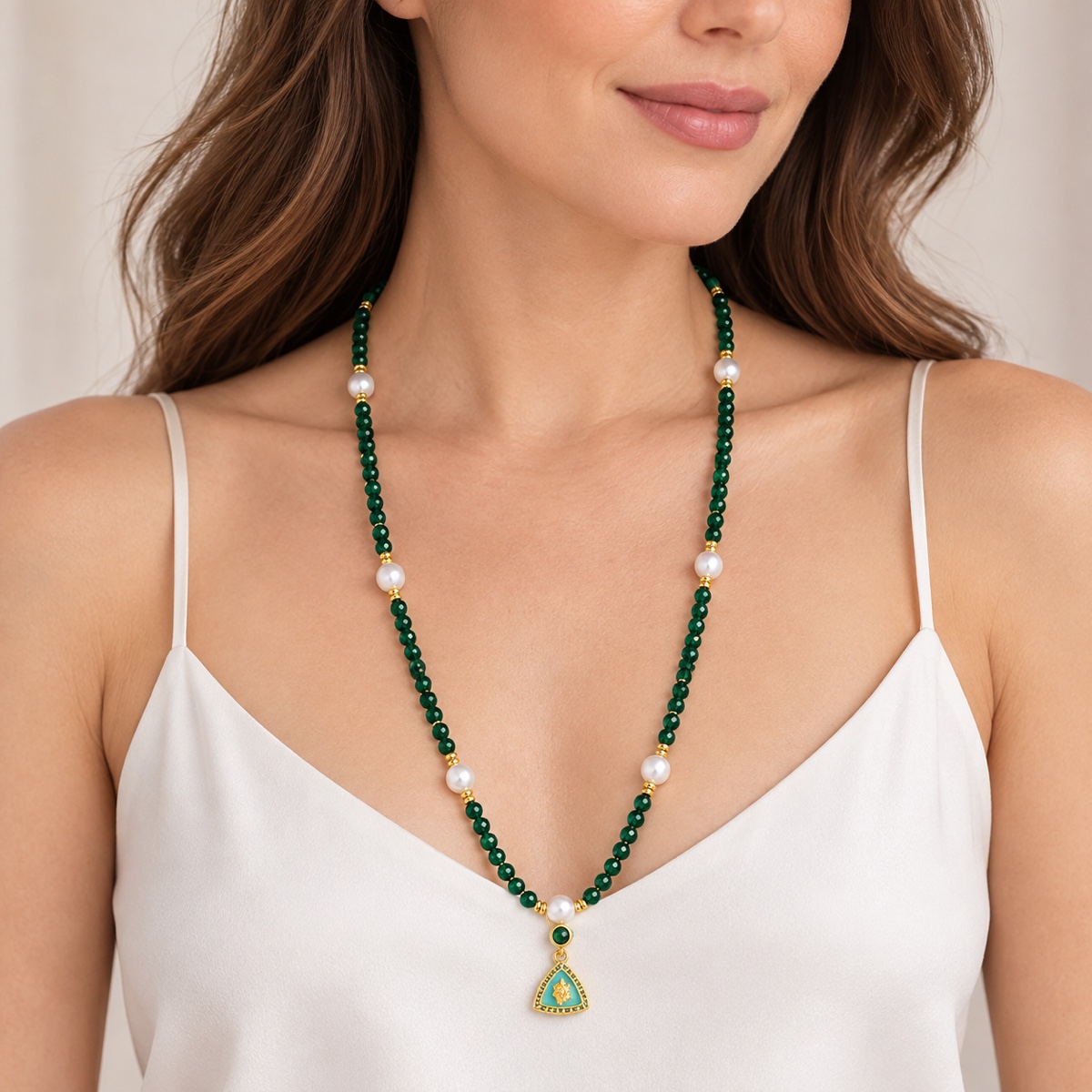
If the neckline already has a print, scarf, or decorative collar, moving the color to the wrist can make the outfit feel less crowded. If the sleeves are simple and the neckline is open, the necklace option may provide the clearer focal point. Evara Vale’s Verselle Clear Orbit Necklace & Wrap Bracelet and Verselle green-pendant convertible design are examples of finished designs intended for either styling path.
A convertible strand moves the same color story from the neckline to a layered wrist look.
Check the look in real life
A mirror shows the composition, but ordinary movement reveals whether it works. Lower your arms, turn your head, sit at a desk, and put on the outer layer you plan to wear. Notice whether the necklace catches in your hair, slips under the neckline, strikes buttons, or competes with a scarf.
Take one quick photo from a normal distance. Close-up inspection emphasizes individual beads, while a full outfit view shows whether the necklace is functioning as a small accent or the main focal point. Make one change at a time so you can tell what improved the balance.
Choosing your first beaded necklace
Use your existing wardrobe as the starting point. If you wear mostly quiet colors and minimal jewelry, begin with a restrained strand or one focused pendant. If you already use prints and layered accessories, a longer or multicolor necklace may fit naturally into your wardrobe.
Before ordering, check the necklace length, construction, color description, focal details, care guidance, and return terms. Photos can help you imagine the styling, but the written product information should guide factual decisions about measurements and materials.
Explore the Evara Vale crystal necklace collection to compare longline, pendant, focal, and beaded silhouettes. Choose the design that works with the clothes and proportions you already enjoy wearing.
If you are choosing between series, our crystal necklaces range is sorted by scale: Aurora covers chip-bead, orb and pendant styles at everyday lengths, and convertible pieces can move between a necklace and a wrap bracelet. A short strand such as this lilac chip necklace layers well under a longer pendant.
Two bracelets can look well matched on a tray and feel awkward together on your wrist. One slides over the other, a charm disappears between the beads, or the colors compete once you put on your jacket.
To build a bracelet stack, start with two pieces and give them something in common: a repeated color, a similar bead shape, or matching metal accents. Then check how they sit when your arm moves. A combination needs to work with your clothes and your day, as well as look good in a close-up.
Choose the bracelet you want to notice first
Pick one bracelet as your starting point. It might have the deepest color, the largest beads, or a charm you particularly like.
The other pieces can support that choice. A purple strand, for example, stands out beside pale pink beads. Add another equally dark, chunky bracelet and the effect becomes bolder; keep the second strand smaller and lighter for a softer combination.
If every bracelet has a large charm or a strong color, try removing one. Look again from a normal distance, with your whole outfit visible. That makes it easier to judge the balance than looking only at your wrist.
Give the colors a connection
You do not need identical colors to make a stack feel coordinated. Try one of these three approaches.
Repeat a color in different proportions
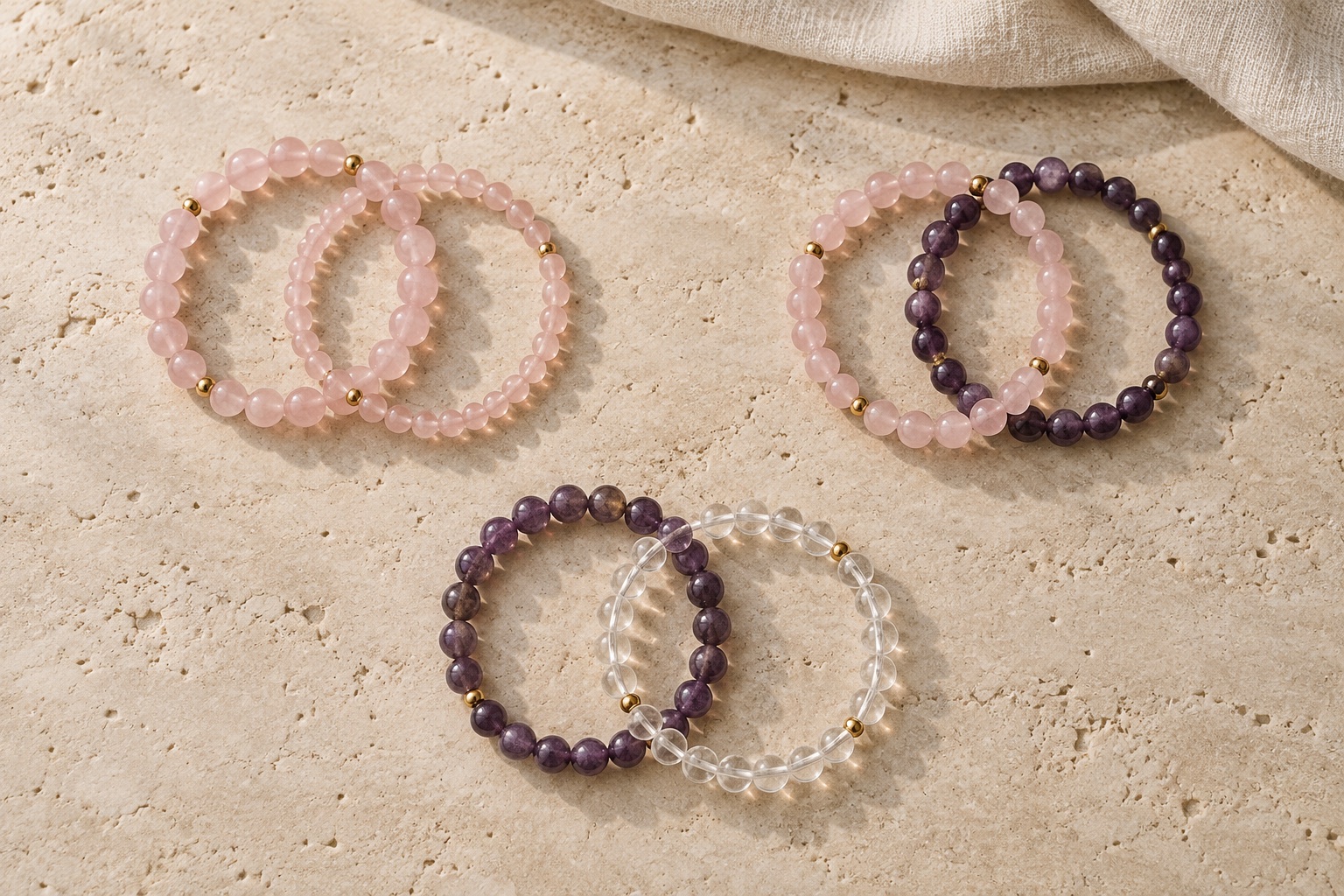
Pair a strand of small pink beads with a larger pink bracelet. The repeated color connects the pieces, while the difference in size keeps them from looking like duplicates. This is a useful starting point if you prefer a restrained look.
Combine a pale color with a deeper one
Pink and purple make a clear example: the lighter strand provides a quiet background, while the darker strand draws attention. With this pairing, a cream shirt leaves both colors easy to see.
Use one shared detail across different colors
A purple strand and a clear-bead bracelet can share small gold-tone spacers. The colors differ, but the repeating metal detail connects them. If you add pink later, keep the accents small so the stack still has a clear focal point.
Three starting points: repeat a color, add contrast, or connect different colors with small metal accents.
You can also take a color from your clothing. A pale-blue bracelet might pick up the blue in a shirt without matching it exactly. If your outfit already has a busy print, try fewer bracelet colors first.
Decide how much space the stack should occupy
Bracelet count alone does not tell you how substantial a stack will look. Three slim strands may take up less room than two bracelets made with large beads.
Start with two, lower your arm, and bend your wrist. Add a third only if you want more color or width.
For a fuller stack, vary the bead sizes rather than choosing every strand at the same scale. A narrow bracelet can sit alongside a larger one without giving both equal visual weight. If the largest beads keep covering the smaller strand, try changing their order or wearing the smaller bracelet on your other wrist.
A stack also extends farther up your arm than a single bracelet. Check each strand where it actually sits; the bracelet closest to your sleeve may feel different from the one beside your hand. Avoid forcing a tight bracelet farther up your arm just to separate the strands.
Leave a charm room to show
A dangling charm needs a little space. Placed in the middle of several thick strands, it may become partly hidden or catch between them.
Try wearing the charm bracelet at the edge of the stack, closer to your hand. Check it with your arm lowered; that is when you can see where the charm naturally falls. If it gets in the way when you bend your wrist, change its position or leave it out of that combination.
For an outfit with a pendant necklace, repeating the metal tone can connect the two areas. You do not need to repeat every shape. A small bracelet charm and a plain necklace can be enough.
Check the stack against your sleeves
Sleeves change how bracelets look and feel. With a loose knit, a broad stack may sit partly under the cuff. Try a narrower pairing if you keep pulling the sleeve back to reveal the beads. Around delicate or open-knit fabric, check that charms and exposed fittings do not snag.
A narrow stack leaves room between the beads and the cuff.
A rolled shirt cuff gives bracelets a defined space. Leave enough room for your wrist to bend without pushing the stack tightly against the fabric.
For desk work, rest your hand in your usual typing position. If beads or charms press into the desk, reduce the stack or move it to your other wrist. A mirror check cannot tell you how the combination feels at a keyboard.
Treat a watch as part of the arrangement
If you wear a watch, include its case and strap when judging the overall width. Begin with one bracelet beside it. Check whether the bracelet moves comfortably and whether its beads or fittings repeatedly rub against the watch.
Wearing bracelets on the opposite wrist is an easy option when the pieces crowd each other. A metal detail can connect a bracelet visually to a watch, but physical compatibility matters too. Follow the care guidance for both pieces rather than assuming they are suitable for constant contact.
Try one change at a time
For a soft everyday look, start with two pink strands in different bead sizes. For stronger contrast, pair pale pink with purple. For a more decorative arrangement, introduce one bracelet with metal accents or a charm.
Change one element at a time. Swapping a single strand makes it easier to see whether you prefer more contrast, a narrower shape, or less movement.
Before heading out, lower your arm, bend your wrist, and check the stack with your sleeves in place. Keep the pieces you enjoy wearing together.
Explore more jewelry and styling inspiration at Evara Vale.
Putting a stack together is easier when you shop by series. Our crystal bracelets collection is organized that way — Clarity Arc double-wraps add a fuller second line without extra pieces, and the Chromara mosaic strand is the one that already carries several colors, so it anchors the arrangement. For a quiet base layer, start with a single strand like this 6 mm clear bead bracelet.
An easy first stack pairs two sizes of the same colorway — a 6 mm strand next to an 8 mm or larger one reads as one considered arrangement rather than two competing pieces.
A bracelet can look delicate in a close-up and feel surprisingly bold once it’s on your wrist. Product photos help you choose a color, but they don’t always tell you how much space the beads will take up—or how the bracelet will sit beside a watch or under a shirt cuff.
Before choosing, separate two measurements: bead diameter and bracelet fit. A listing that says “6mm” describes the beads, not the wrist the bracelet will fit.
Here’s how to make sense of both, then choose a combination you’ll enjoy wearing.
Start with the look you want
Think about what you already wear.
If you usually choose a fine chain or a small pendant, a strand of smaller beads is a sensible place to start. If you want the bracelet to be the main detail in an otherwise simple outfit, consider larger beads or a stronger color.
Color changes the effect, too. Pale pink sits softly against a light sleeve, while purple creates a more distinct line around the wrist. A pale-blue strand can still stand out if the beads have a fuller silhouette.
Styling images can help you explore those combinations, but they don’t establish a bead’s material, exact diameter, or weight. Check those details in the description before buying.
What changes between 6mm, 7mm, and 8mm beads?
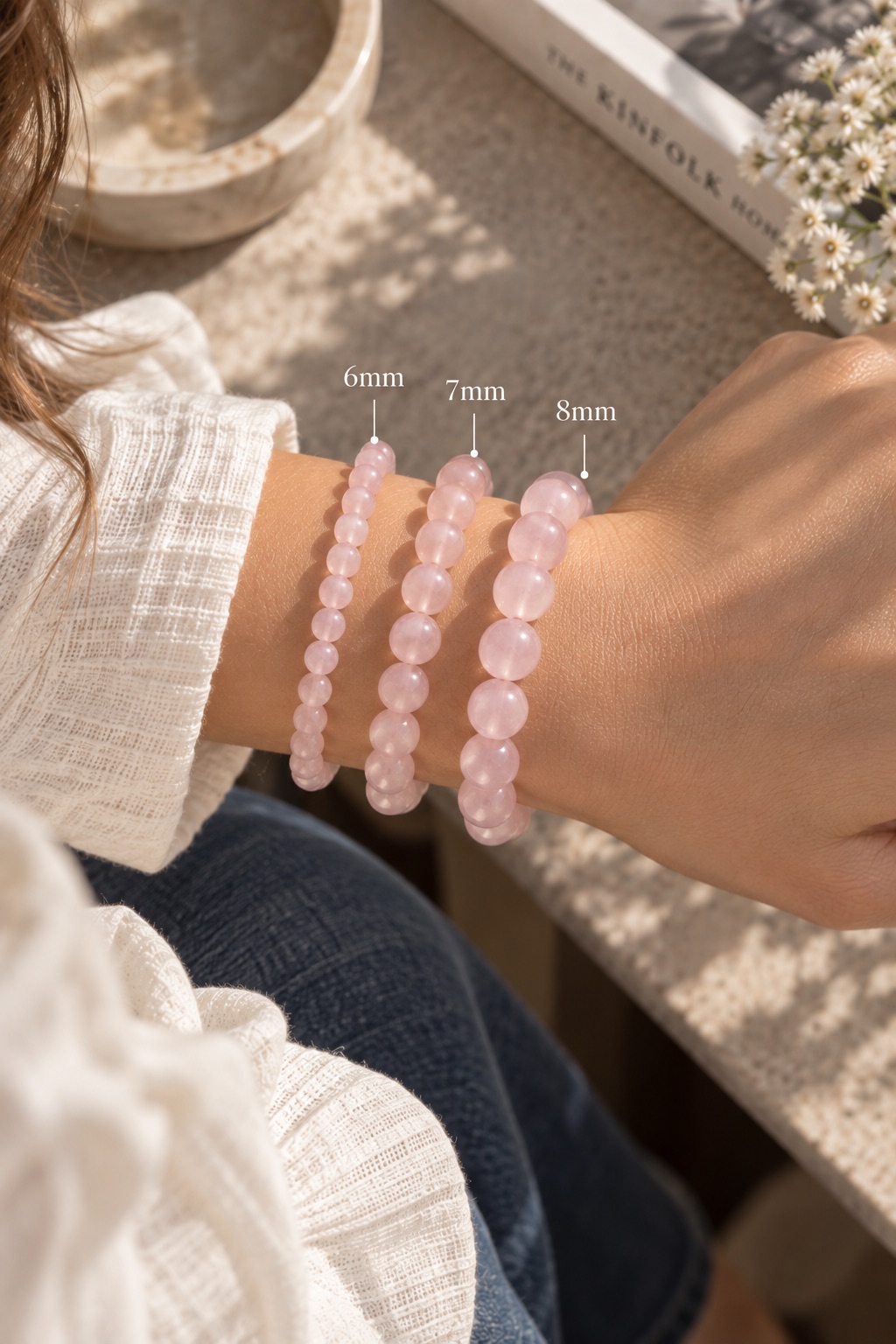
For round beads, the millimeter measurement refers to the diameter of an individual bead. The difference between 6mm and 8mm is just 2mm across each bead, but that change repeats around the entire bracelet.
Bead size
Visual effect
Consider it if…
6mm
A finer line around the wrist
You prefer understated jewelry or want to layer several strands
7mm
A middle step between fine and fuller beads
You want a little more presence without moving straight to 8mm
8mm
A fuller, more noticeable strand
You want to wear one bracelet as the main wrist accessory
These are starting points, not rules about which size belongs on which wrist. A smaller wrist can wear a bold bracelet; a larger wrist can wear a fine strand. Choose the proportion you like, then check the fit separately.
A dark strand can draw more attention than a pale strand of the same diameter. Compare similar colors when you’re trying to judge size alone.
Illustrative bead-size comparison. Refer to product measurements for actual dimensions.
Be careful with close-up photos
A bracelet that fills the screen may still have small beads. Camera distance, cropping, and wrist proportions all affect how large it appears.
For a more useful reference, measure a round bead on a bracelet you already own. A ruler can give you a rough comparison; calipers are better for checking small differences. Keep that measurement in mind when looking at another design.
Measure your wrist before choosing a bracelet size
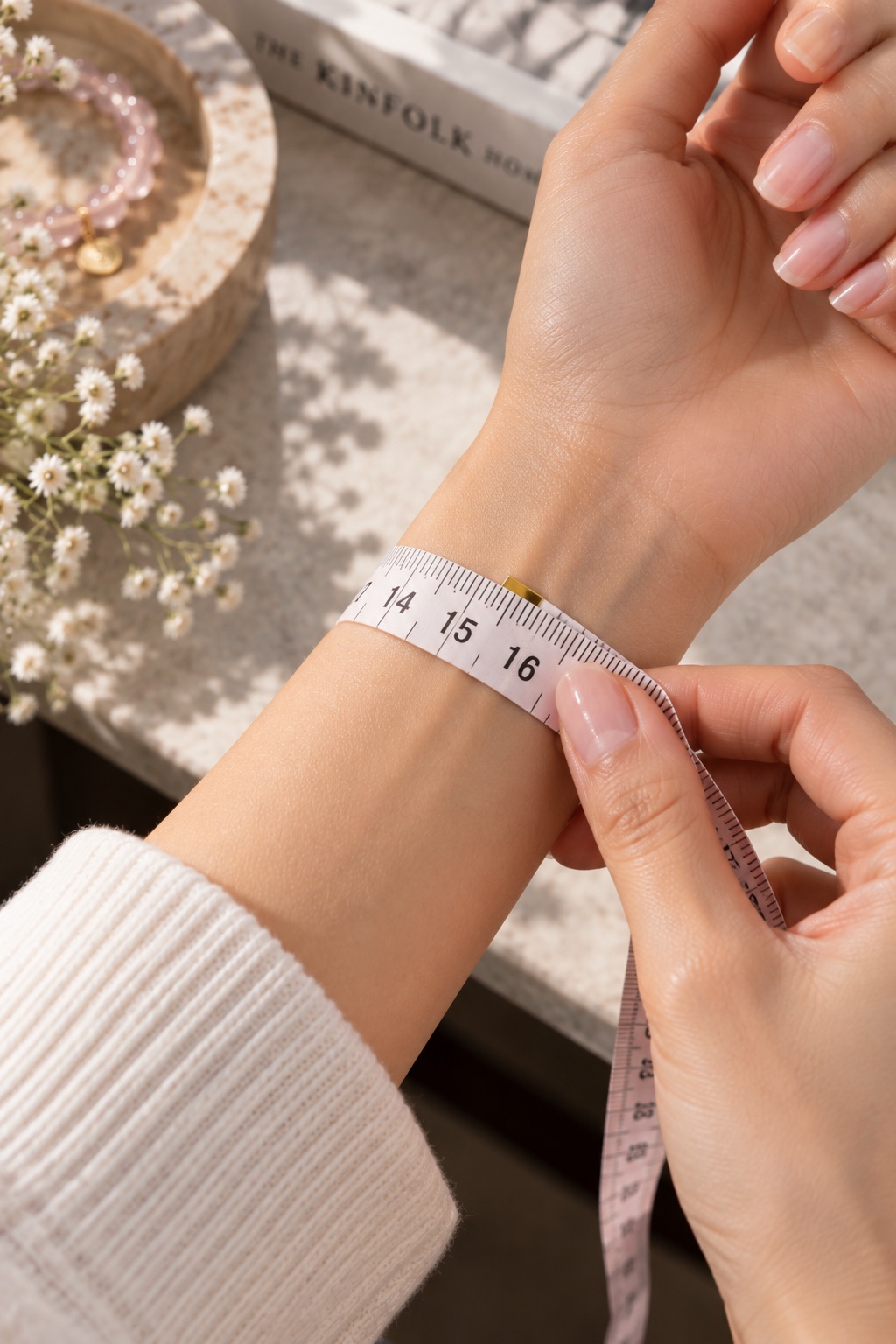
Use a flexible measuring tape around the place where you want the bracelet to sit. Keep it against your skin without pulling it tight, and read the measurement where the starting end meets the tape.
If you don’t have a measuring tape:
Wrap a narrow strip of paper around your wrist.
Mark where the end overlaps.
Lay it flat and measure from the starting end to the mark.
Record the actual wrist measurement first. Add any allowance only after checking how the seller defines its sizes.
Wrap the tape where you want the bracelet to sit. Read your own measurement at the overlap.
Check what the size on the listing means
“Bracelet size” can refer to a recommended wrist measurement, an inside circumference, or the length of the strand laid flat. Those measurements are not interchangeable.
For example, a bracelet recommended for a 6-inch wrist is not necessarily a bracelet measuring 6 inches from end to end. Beads take up space inside the loop, and larger beads can affect that space.
If the description is unclear, ask:
My wrist measures ___ inches/cm. Which size would you recommend for a fit with a little movement?
That gives the seller something more useful than “I have a small wrist.”
Decide how much movement you like
Some people want a bracelet to stay near the wrist bone. Others like it to slide slightly when they move. Consider when you’ll wear it: typing at a desk, wearing fitted sleeves, or stacking it beside other jewelry can make the same fit feel different.
Close fit: The bracelet stays mostly in place. It should not pinch or require the elastic to stay stretched while you wear it.
Some movement: The bracelet can shift slightly as you turn your wrist. This gives you room to move without letting the strand travel far down the hand.
Loose fit: The bracelet moves farther along the wrist and may sit lower toward the hand. Check that it won’t slip off during ordinary movement.
Don’t rely on stretch alone to solve a sizing mismatch. Elastic helps a bracelet pass over your hand; the finished bracelet still needs to fit your wrist.
Build a stack one strand at a time
Start with the bracelet you most want to wear, then add one supporting piece.
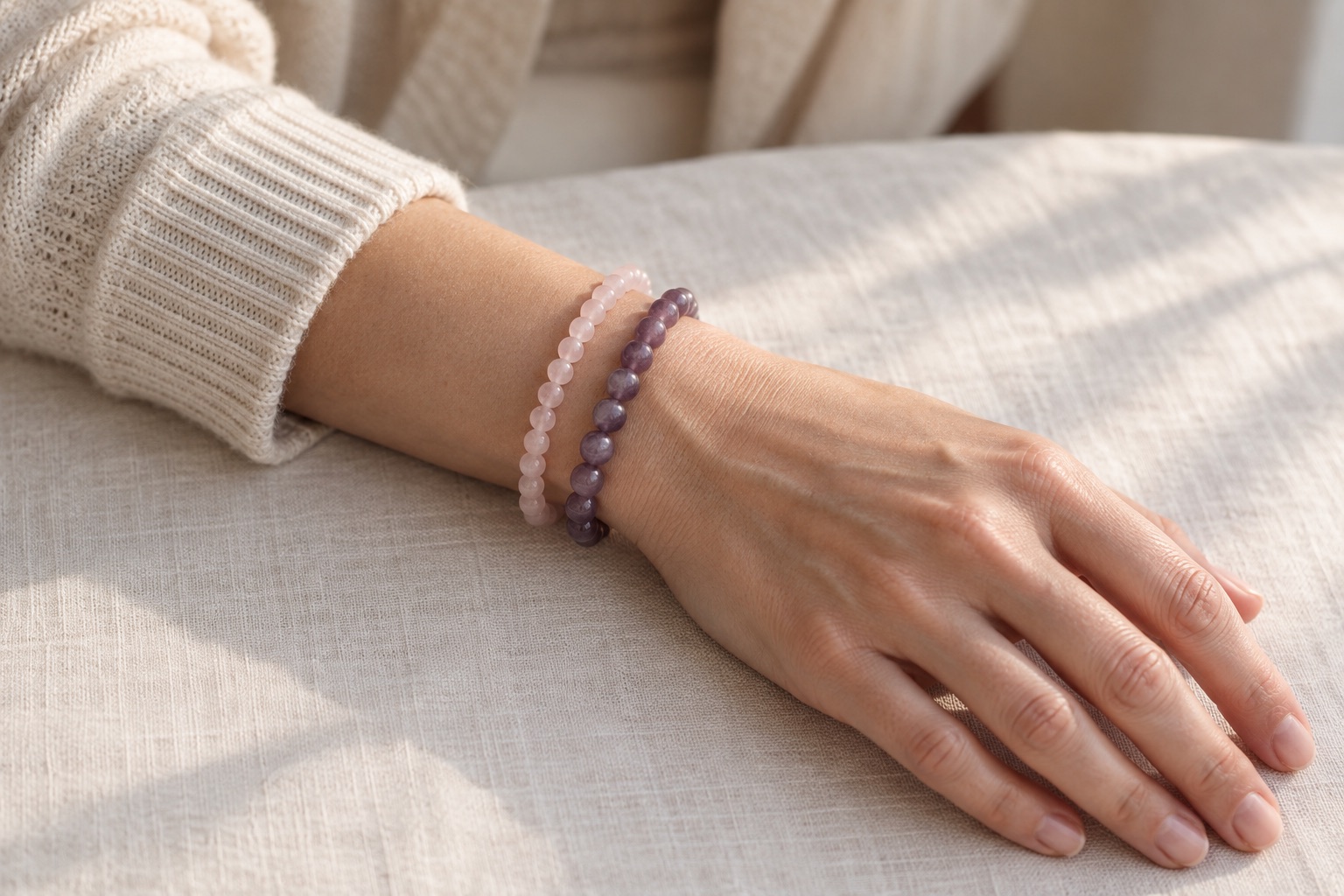
Try repeating pink across two strands, adding purple for contrast, and using clear-looking beads to provide a lighter band between colors. Repeated gold-tone details can connect the strands visually.
You can use that arrangement without matching every bracelet:
Repeat one color across two strands.
Add a contrasting color if you want more definition.
Let one charm or larger bead be the focal point.
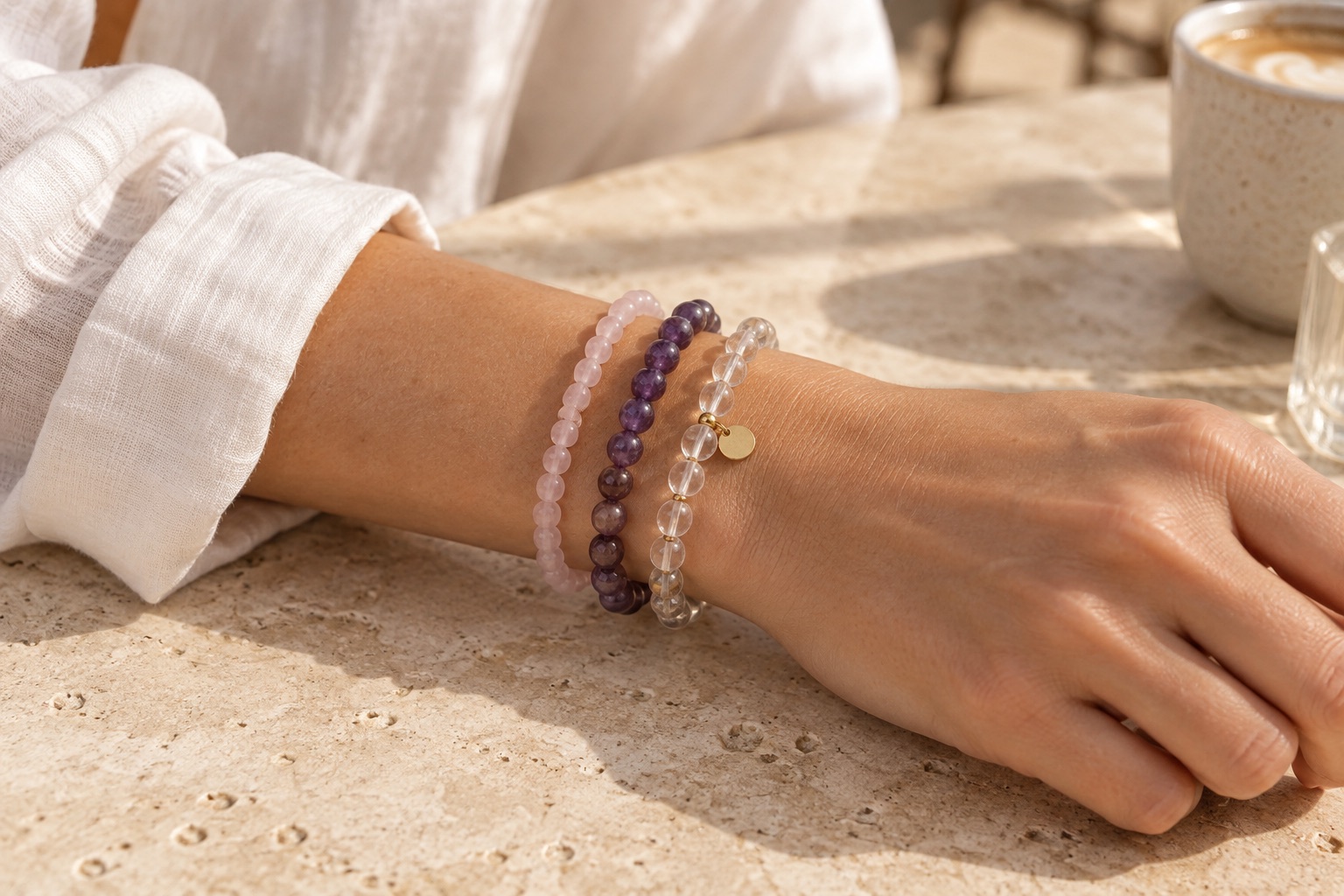
Styling inspiration: repeat a color and use one focal detail to connect the stack.
Try the stack with your actual sleeves and watch. Bend your wrist and rest your hand on a desk. If the bracelets crowd each other or make the cuff awkward, remove a strand and try again.
A single bracelet may work better for some days. There’s no required number of layers.
Before you place an order
Once you’ve chosen the look, check the details a photo can’t confirm:
Material: Color alone doesn’t identify a gemstone or establish whether a bead is natural, manufactured, or treated.
Fit: Look for the recommended wrist range and how the bracelet was measured.
Construction: Check whether it uses elastic, a clasp, or an adjustable closure.
Metal components: Confirm the material if you have known sensitivities.
Returns: Read the sizing and return terms, especially when buying a gift.
If you’re choosing between two bead sizes, use the jewelry you already reach for as your reference. A finer strand makes sense if you like subtle accessories. A fuller strand is worth considering if you want one piece to carry the look.
For more beaded jewelry inspiration, visit Evara Vale.
Ready to choose? Browse our crystal bracelets, or go straight to a series if you already know what you want: the Luminelle series is the delicate end of the range, while Aqualume runs from 4 mm up to 8 mm so you can compare sizes side by side. If you’d rather not think about sizing at all, a double-wrap style covers more of the wrist with the same beads.
Sizing comes down to how much of the wrist you want the bracelet to cover — a 6 mm strand sits close and light, while an 8 mm or larger bead fills more of the wrist on its own.
To provide the best experiences, we use technologies like cookies to store and/or access device information. Consenting to these technologies will allow us to process data such as browsing behavior or unique IDs on this site. Not consenting or withdrawing consent, may adversely affect certain features and functions.
Functional
Always active
The technical storage or access is strictly necessary for the legitimate purpose of enabling the use of a specific service explicitly requested by the subscriber or user, or for the sole purpose of carrying out the transmission of a communication over an electronic communications network.
Preferences
The technical storage or access is necessary for the legitimate purpose of storing preferences that are not requested by the subscriber or user.
Statistics
The technical storage or access that is used exclusively for statistical purposes.The technical storage or access that is used exclusively for anonymous statistical purposes. Without a subpoena, voluntary compliance on the part of your Internet Service Provider, or additional records from a third party, information stored or retrieved for this purpose alone cannot usually be used to identify you.
Marketing
The technical storage or access is required to create user profiles to send advertising, or to track the user on a website or across several websites for similar marketing purposes.