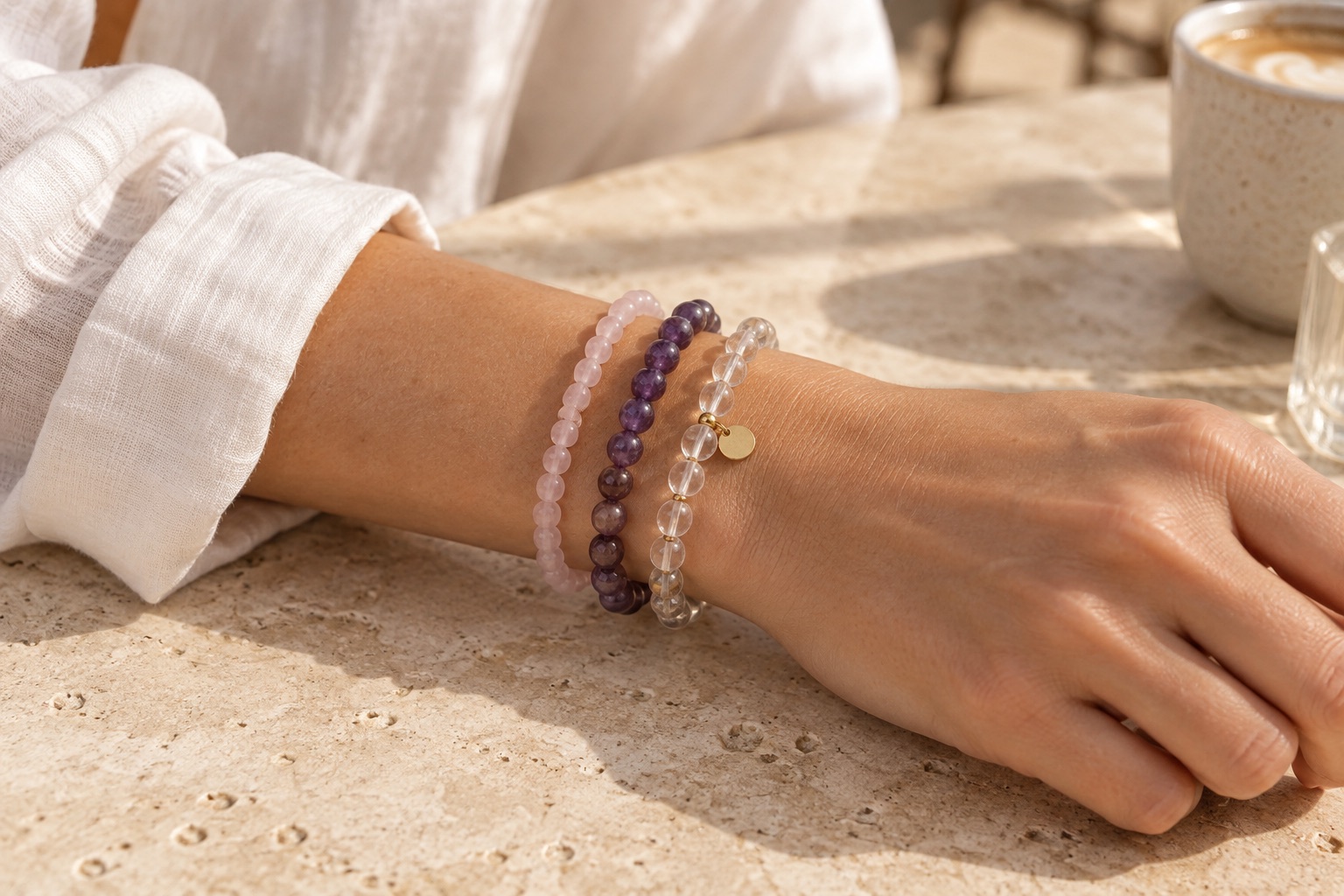
Two bracelets can look well matched on a tray and feel awkward together on your wrist. One slides over the other, a charm disappears between the beads, or the colors compete once you put on your jacket.
To build a bracelet stack, start with two pieces and give them something in common: a repeated color, a similar bead shape, or matching metal accents. Then check how they sit when your arm moves. A combination needs to work with your clothes and your day, as well as look good in a close-up.
Choose the bracelet you want to notice first
Pick one bracelet as your starting point. It might have the deepest color, the largest beads, or a charm you particularly like.
The other pieces can support that choice. A purple strand, for example, stands out beside pale pink beads. Add another equally dark, chunky bracelet and the effect becomes bolder; keep the second strand smaller and lighter for a softer combination.
If every bracelet has a large charm or a strong color, try removing one. Look again from a normal distance, with your whole outfit visible. That makes it easier to judge the balance than looking only at your wrist.
Give the colors a connection
You do not need identical colors to make a stack feel coordinated. Try one of these three approaches.
Repeat a color in different proportions
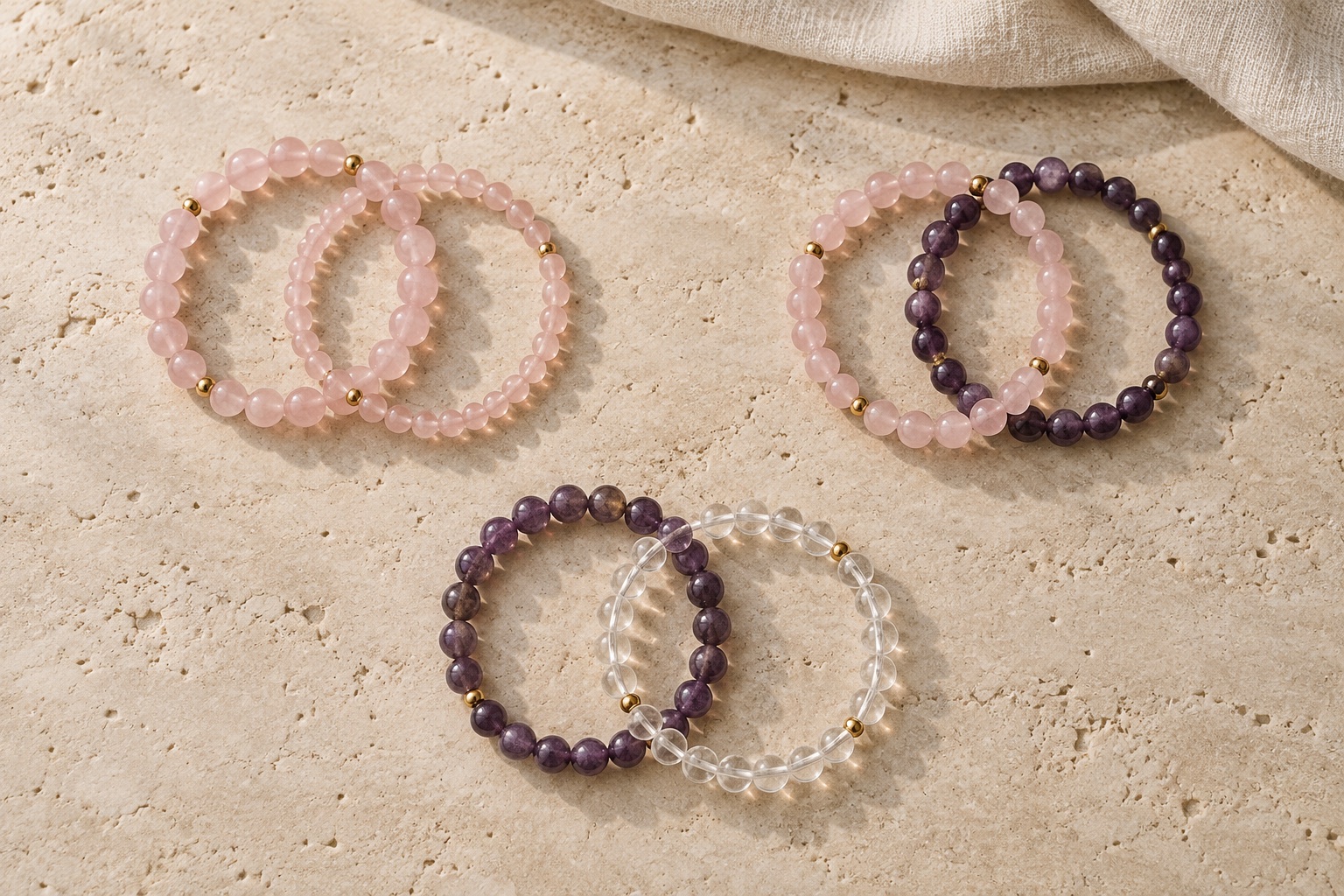
Pair a strand of small pink beads with a larger pink bracelet. The repeated color connects the pieces, while the difference in size keeps them from looking like duplicates. This is a useful starting point if you prefer a restrained look.
Combine a pale color with a deeper one
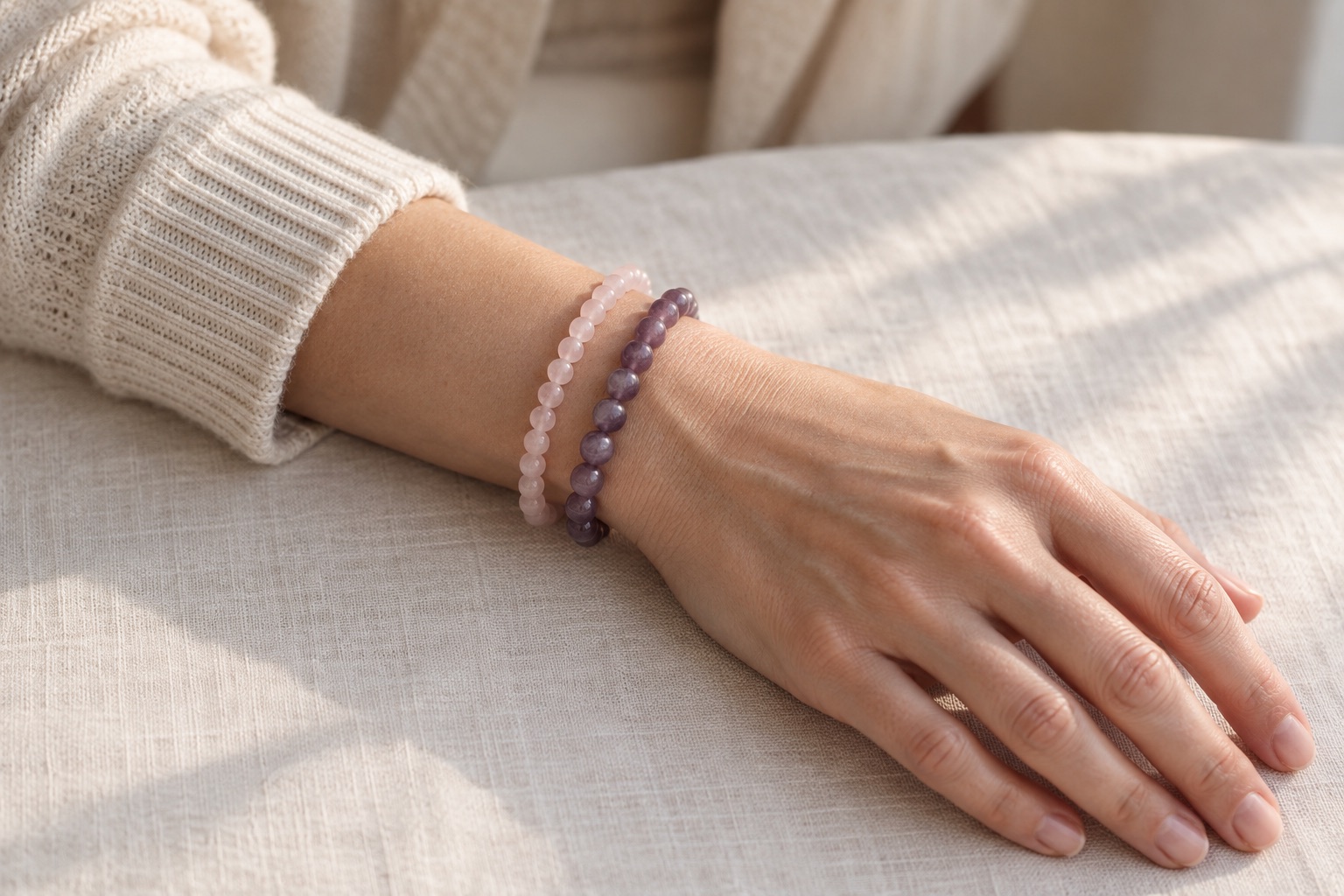
Pink and purple make a clear example: the lighter strand provides a quiet background, while the darker strand draws attention. With this pairing, a cream shirt leaves both colors easy to see.
Use one shared detail across different colors
A purple strand and a clear-bead bracelet can share small gold-tone spacers. The colors differ, but the repeating metal detail connects them. If you add pink later, keep the accents small so the stack still has a clear focal point.
You can also take a color from your clothing. A pale-blue bracelet might pick up the blue in a shirt without matching it exactly. If your outfit already has a busy print, try fewer bracelet colors first.
Decide how much space the stack should occupy
Bracelet count alone does not tell you how substantial a stack will look. Three slim strands may take up less room than two bracelets made with large beads.
Start with two, lower your arm, and bend your wrist. Add a third only if you want more color or width.
For a fuller stack, vary the bead sizes rather than choosing every strand at the same scale. A narrow bracelet can sit alongside a larger one without giving both equal visual weight. If the largest beads keep covering the smaller strand, try changing their order or wearing the smaller bracelet on your other wrist.
A stack also extends farther up your arm than a single bracelet. Check each strand where it actually sits; the bracelet closest to your sleeve may feel different from the one beside your hand. Avoid forcing a tight bracelet farther up your arm just to separate the strands.
Leave a charm room to show
A dangling charm needs a little space. Placed in the middle of several thick strands, it may become partly hidden or catch between them.
Try wearing the charm bracelet at the edge of the stack, closer to your hand. Check it with your arm lowered; that is when you can see where the charm naturally falls. If it gets in the way when you bend your wrist, change its position or leave it out of that combination.
For an outfit with a pendant necklace, repeating the metal tone can connect the two areas. You do not need to repeat every shape. A small bracelet charm and a plain necklace can be enough.
Check the stack against your sleeves
Sleeves change how bracelets look and feel. With a loose knit, a broad stack may sit partly under the cuff. Try a narrower pairing if you keep pulling the sleeve back to reveal the beads. Around delicate or open-knit fabric, check that charms and exposed fittings do not snag.
A rolled shirt cuff gives bracelets a defined space. Leave enough room for your wrist to bend without pushing the stack tightly against the fabric.
For desk work, rest your hand in your usual typing position. If beads or charms press into the desk, reduce the stack or move it to your other wrist. A mirror check cannot tell you how the combination feels at a keyboard.
Treat a watch as part of the arrangement
If you wear a watch, include its case and strap when judging the overall width. Begin with one bracelet beside it. Check whether the bracelet moves comfortably and whether its beads or fittings repeatedly rub against the watch.
Wearing bracelets on the opposite wrist is an easy option when the pieces crowd each other. A metal detail can connect a bracelet visually to a watch, but physical compatibility matters too. Follow the care guidance for both pieces rather than assuming they are suitable for constant contact.
Try one change at a time
For a soft everyday look, start with two pink strands in different bead sizes. For stronger contrast, pair pale pink with purple. For a more decorative arrangement, introduce one bracelet with metal accents or a charm.
Change one element at a time. Swapping a single strand makes it easier to see whether you prefer more contrast, a narrower shape, or less movement.
Before heading out, lower your arm, bend your wrist, and check the stack with your sleeves in place. Keep the pieces you enjoy wearing together.
Explore more jewelry and styling inspiration at Evara Vale.
Putting a stack together is easier when you shop by series. Our crystal bracelets collection is organized that way — Clarity Arc double-wraps add a fuller second line without extra pieces, and the Chromara mosaic strand is the one that already carries several colors, so it anchors the arrangement. For a quiet base layer, start with a single strand like this 6 mm clear bead bracelet.
An easy first stack pairs two sizes of the same colorway — a 6 mm strand next to an 8 mm or larger one reads as one considered arrangement rather than two competing pieces.